What Is SIP In The Session Layer: Session Initiation Protocol
Category: NETWORKING | 25th September 2026, Friday
Introduction
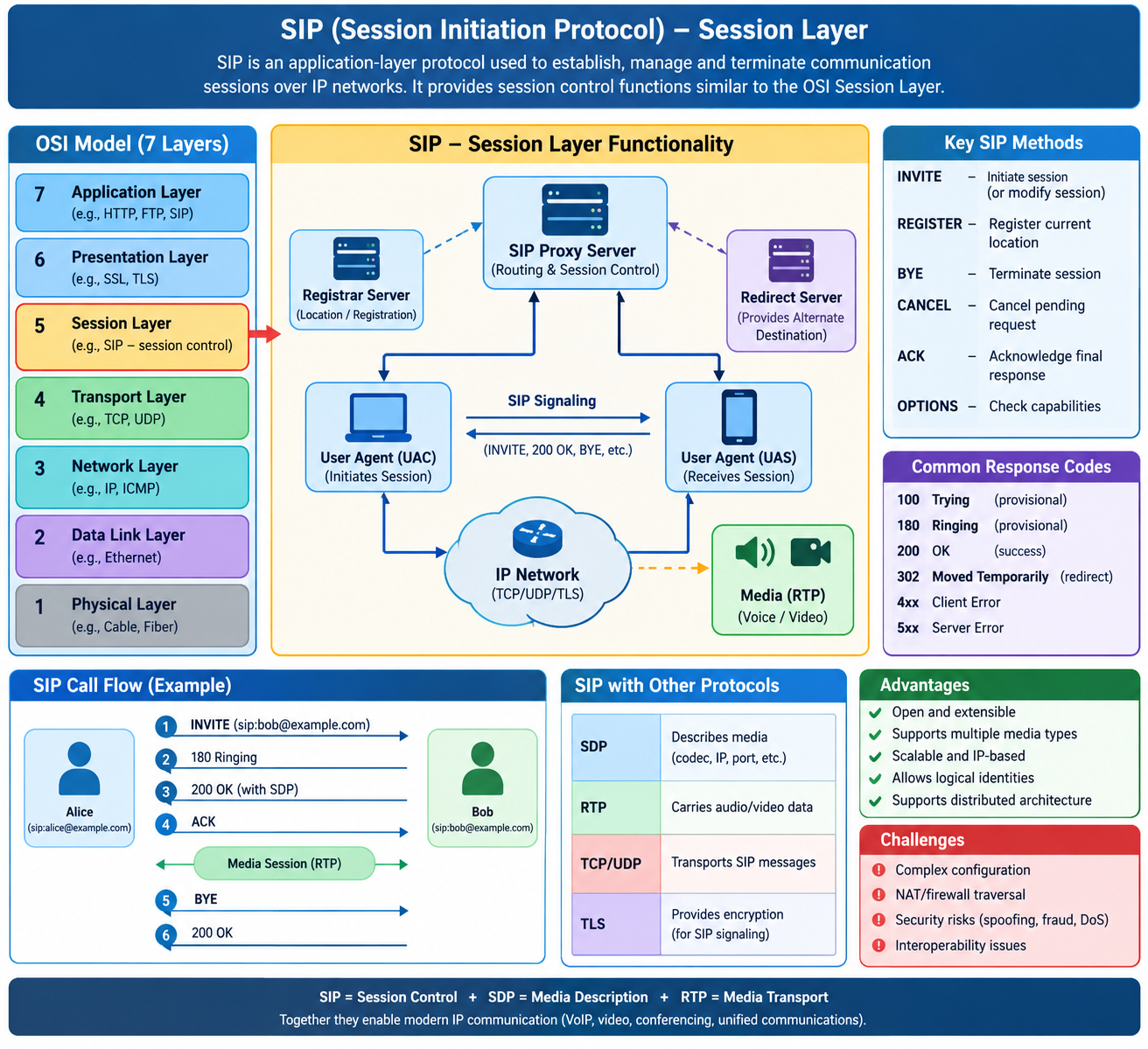
SIP, Or Session Initiation Protocol, Is An Application-layer Signaling Protocol Used To Establish, Modify, Manage, And Terminate Communication Sessions Over Internet Protocol (IP) Networks. SIP Is Widely Associated With Voice Over IP (VoIP), Video Calling, Instant Messaging, Conferencing, And Other Real-time Communication Services. Although SIP Is Often Discussed In Relation To The Session Layer Of The OSI Model, It Is Technically An application-layer Protocol In The TCP/IP Architecture. Its Functions Overlap Conceptually With Several Responsibilities Associated With The OSI Session Layer.
SIP And The OSI Session Layer
The OSI Session Layer Is Responsible For Establishing, Managing, Synchronizing, And Terminating Communication Sessions Between Applications. SIP Performs Many Similar Session-management Functions, Which Is Why It Is Frequently Studied As A Session Layer-related Protocol. However, SIP Does Not Literally Operate At OSI Layer 5. In Practical Internet Networking, SIP Belongs To The Application Layer And Works Together With Protocols Such As TCP, UDP, TLS, RTP, And SDP To Provide Complete Real-time Communication.
Full Form Of SIP
The Full Form Of SIP Is Session Initiation Protocol. It Was Designed As A Signaling Protocol For Initiating And Controlling Multimedia Communication Sessions. SIP Does Not Normally Carry The Actual Voice Or Video Media. Instead, It Establishes The Communication Relationship And Negotiates Session Parameters. After A Session Is Established, Protocols Such As RTP Generally Transport Audio And Video Streams Between Participants.
Purpose Of SIP
The Primary Purpose Of SIP Is To Control Communication Sessions Between Network Endpoints. It Can Locate Users, Determine Their Availability, Establish Sessions, Negotiate Capabilities, Modify An Existing Session, And Terminate Communication. For Example, When One Person Makes An Internet Phone Call To Another Person, SIP Can Be Used To Locate The Destination Device, Establish The Call, Negotiate Media Capabilities, And Later Terminate The Call.
SIP As A Signaling Protocol
SIP Is Fundamentally A signaling Protocol. Signaling Means Exchanging Control Information Before, During, And After A Communication Session. Consider A VoIP Call. The Actual Voice Consists Of Continuous Audio Packets, While SIP Messages Communicate Information Such As Who Is Calling, Who Is Being Called, Which Media Formats Are Supported, And Whether The Call Has Been Accepted. SIP Therefore Controls The Session Rather Than Serving As The Primary Voice Transport Mechanism.
SIP Architecture
SIP Uses A Distributed Architecture Containing Several Important Components. Major SIP Entities Include User Agents, Proxy Servers, Registrar Servers, Redirect Servers, And Location Servers. These Components Cooperate To Locate Users And Establish Sessions. SIP's Architecture Allows Users To Move Between Networks Or Devices While Maintaining A Logical Identity Represented By A SIP Uniform Resource Identifier, Or SIP URI.
User Agent
A User Agent (UA) Is A SIP Endpoint That Participates In Communication. A Software-based VoIP Application, IP Telephone, Video Conferencing Application, Or Communication Device Can Function As A User Agent. A User Agent Can Act As A User Agent Client (UAC) When It Sends A SIP Request And As A User Agent Server (UAS) When It Receives A Request And Generates A Response.
SIP Proxy Server
A SIP Proxy Server Receives SIP Requests And Forwards Them Toward Their Destination. It Can Perform Routing, Authentication, Policy Enforcement, And Other Signaling Functions. For Example, When A User Attempts To Call Another SIP User, The Proxy May Determine Where The Destination User Is Currently Registered And Forward The Request Toward The Appropriate Device. Proxies Can Therefore Simplify Communication Between Users Located On Different Networks.
SIP Registrar
A Registrar Server Handles SIP Registration Requests. When A User Connects A SIP Telephone Or Application To A Network, The Device Can Send A REGISTER Request To Inform The SIP Infrastructure About Its Current Location. The Registrar Records The Association Between The User's SIP Identity And The Device's Current Network Address. This Information Can Subsequently Be Used To Route Incoming Calls.
SIP Redirect Server
A Redirect Server Provides Information About Where A SIP Request Should Be Sent Rather Than Forwarding The Request Itself. When It Receives A Request, It Can Return A Response Containing An Alternative Destination. The Originating Client Can Then Contact That Destination Directly Or Through Another SIP Server. This Approach Can Reduce The Processing And Routing Responsibilities Of Intermediary Servers.
SIP Location Service
A Location Service Maintains Information About The Current Locations Or Contact Addresses Associated With SIP Users. When A SIP User Registers, The Registrar Can Update This Information. A Proxy Or Redirect Server Can Query The Location Information When Attempting To Locate A User. This Mechanism Is Particularly Useful Because Users May Register From Different Devices Or Locations Over Time.
SIP URI
SIP Uses Identifiers Known As SIP URIs. A SIP URI Resembles An Email Address And Commonly Follows A Structure Such As sip:user@example.com. It Identifies A SIP User Or Service Rather Than Necessarily Identifying A Particular Physical Device. SIP URIs Allow Communication Systems To Use Logical Identities That Can Be Mapped To Current Network Locations.
SIP Signaling Process
A Typical SIP Communication Begins With Signaling Between The Caller And The Communication Infrastructure. The Caller Sends An INVITE Request To Initiate A Session. The Destination May Respond With Provisional Messages Such As 100 Trying And 180 Ringing. If The Destination Accepts The Session, It Normally Sends A 200 OK Response. The Caller Then Sends An ACK, Completing The Basic SIP Call-establishment Exchange.
INVITE Method
The INVITE Method Is One Of The Most Important SIP Methods. It Is Used To Initiate A Session Or Modify An Existing Session. An INVITE Can Contain Information Describing The Desired Communication, Such As Supported Codecs And Media Types. This Information Is Frequently Represented Using The Session Description Protocol (SDP). The Receiving Endpoint Can Examine The Proposed Session Parameters And Respond Accordingly.
REGISTER Method
The REGISTER Method Allows A SIP Endpoint To Inform A Registrar About Its Current Contact Address. For Example, A User May Have A SIP Account Associated With A Particular Identity But Connect From A Dynamically Assigned IP Address. The Device Can Register Its Current Contact Information With The SIP Server. Incoming Communication Can Then Be Routed Toward The Registered Endpoint.
BYE Method
The BYE Method Is Used To Terminate An Established SIP Session. When A Participant Wants To End A Call, A BYE Request Can Be Sent To The Other Endpoint Or Through The Appropriate SIP Infrastructure. The Receiving Endpoint Responds To Confirm The Request. BYE Therefore Provides A Standardized Mechanism For Terminating An Active Communication Session.
CANCEL Method
The CANCEL Method Is Used To Cancel A Pending SIP Request, Particularly An INVITE That Has Not Yet Resulted In An Established Session. For Example, If A Caller Hangs Up While The Destination Telephone Is Still Ringing, The Originating System May Send CANCEL. This Prevents Unnecessary Continuation Of A Call-establishment Process.
ACK Method
ACK, Short For Acknowledgement, Confirms The Receipt Of Certain Final Responses To An INVITE Transaction. During A Successful Call Setup, The Destination Sends A 200 OK Response And The Originating Endpoint Sends ACK. This Provides Confirmation That The Final Response Was Received And Allows The Session Establishment Process To Proceed Correctly.
OPTIONS Method
The OPTIONS Method Is Used To Query The Capabilities Of A SIP Endpoint Or Server. It Can Help Determine Which SIP Methods, Extensions, Media Types, Or Capabilities Are Supported. Network Administrators And Communication Systems Can Use OPTIONS For Capability Discovery And Diagnostic Purposes. It Can Therefore Provide Useful Information Without Necessarily Establishing A Communication Session.
SIP Response Codes
SIP Responses Use Numerical Status Codes Similar In Concept To HTTP Status Codes. They Are Divided Into Several Categories. 1xx Responses Are Provisional, 2xx Responses Indicate Success, 3xx Responses Indicate Redirection, 4xx Responses Indicate Client-related Errors, 5xx Responses Indicate Server Errors, And 6xx Responses Indicate Global Failures. For Example, 180 Ringing Indicates That The Destination Is Being Alerted, While 200 OK Indicates Successful Processing.
SDP And SIP
SIP Commonly Works With Session Description Protocol (SDP) To Describe The Media Characteristics Of A Communication Session. SDP Can Specify Information Such As Media Type, Codec, Transport Protocol, IP Address, And Port. SIP Transports Or References SDP Information During Signaling. SIP Therefore Establishes The Signaling Relationship While SDP Helps Participants Negotiate The Characteristics Of The Media Session.
SIP And RTP
SIP And Real-time Transport Protocol (RTP) Have Different Responsibilities. SIP Establishes And Manages The Session, Whereas RTP Normally Carries Real-time Audio And Video Packets. During A VoIP Call, SIP May Negotiate The Media Parameters And Establish The Session, While RTP Subsequently Transports The Voice Packets. This Separation Between Signaling And Media Transport Is Fundamental To Many IP Communication Systems.
SIP Transport Protocols
SIP Can Operate Over Different Transport Protocols, Including UDP, TCP, And TLS-protected TCP. UDP Can Provide Relatively Low Signaling Overhead, While TCP Can Provide Reliable Transport For SIP Messages. SIP Over TLS, Commonly Called SIPS When Appropriate URI Usage Is Involved, Provides Encryption For SIP Signaling. The Selected Transport Depends On The Architecture, Security Requirements, Network Environment, And Implementation.
SIP Over UDP
UDP Has Historically Been Widely Used For SIP Signaling Because It Has Low Overhead And Does Not Require A Connection-oriented Transport Mechanism. SIP Provides Its Own Transaction Mechanisms To Handle Message Retransmission In Situations Where UDP Is Used. However, Modern Deployments May Use TCP Or Other Transports Where Reliability, Message Size, Or Network Policy Makes Them More Suitable.
SIP Over TCP
SIP Can Also Operate Over TCP. TCP Provides Reliable, Ordered Delivery Of SIP Messages. This Can Be Useful When SIP Messages Are Large Or When Network Infrastructure Prefers Connection-oriented Signaling. TCP Also Avoids Some Of The Message-size Limitations And Fragmentation Concerns Associated With Larger SIP Messages Transmitted Using UDP.
SIP Security
Security Is An Important Consideration For SIP-based Communication. SIP Signaling Can Potentially Contain Sensitive Information Such As User Identities, Network Addresses, Call-routing Information, And Session Parameters. TLS Can Be Used To Protect SIP Signaling Between Endpoints And Servers Or Between SIP Infrastructure Components. Authentication Mechanisms Can Also Help Prevent Unauthorized Users From Registering Or Initiating Communication.
SIP Authentication
SIP Commonly Supports Authentication Mechanisms Based On Challenge-response Procedures. A SIP Server May Challenge A Client Before Accepting Requests Such As REGISTER Or INVITE. The Client Provides Credentials That Allow The Server To Verify Its Identity. Proper Authentication Helps Prevent Unauthorized Access To SIP Accounts And Reduces The Risk Of Fraudulent Signaling Activities.
NAT And SIP
Network Address Translation (NAT) Can Create Challenges For SIP Because SIP Messages May Contain IP Addresses And Port Information Related To Media Communication. A Device Behind A NAT Gateway May Advertise An Internal Address That Cannot Be Directly Reached From The Internet. SIP Deployments Therefore Often Use Techniques And Supporting Protocols Such As STUN, TURN, And ICE To Improve Connectivity Through NAT And Firewall Environments.
SIP Session Modification
SIP Is Not Limited To Creating Sessions. It Can Also Modify An Existing Communication Session. For Example, Participants May Add Video To An Audio Call, Place A Call On Hold, Change Media Parameters, Or Renegotiate Codecs. SIP Re-INVITE And Related Mechanisms Can Be Used To Communicate Such Changes. This Flexibility Makes SIP Suitable For Sophisticated Multimedia Communication Systems.
SIP Conferencing
SIP Can Support Communication Involving Multiple Participants. Conferencing Systems Can Use SIP Signaling To Establish Connections Between Participants And Conference Services. A Conference Server May Provide Functions Such As Participant Management, Media Mixing, Authentication, And Session Control. SIP's Extensibility Allows It To Support A Wide Range Of Enterprise And Telecommunications Conferencing Architectures.
SIP For Instant Messaging
Although SIP Is Strongly Associated With VoIP, Its Ecosystem Can Also Support Messaging-related Communication. SIP-based Systems Have Historically Been Used For Presence And Instant Messaging Through Extensions And Related Standards. A User Can Publish Availability Information And Communicate Through Compatible Signaling Infrastructure. Modern Messaging Platforms, However, May Use Different Protocols Depending On Their Architecture.
SIP Presence
Presence Refers To Information About A User's Communication Availability Or Status. SIP-based Presence Mechanisms Can Allow Users To Indicate States Such As Available, Busy, Away, Or Unavailable. Presence Information Can Help Communication Systems Determine Whether A Person Is Currently Reachable. It Can Also Support Unified Communication Environments Where Voice, Video, Messaging, And Conferencing Are Integrated.
SIP In VoIP
SIP Is One Of The Most Important Signaling Protocols Used In Voice Over IP Systems. Traditional Telephone Networks Use Specialized Signaling Systems To Establish Calls, While VoIP Networks Can Use SIP To Perform Similar Session-control Functions Over IP. SIP-based VoIP Systems Can Support Features Such As Call Forwarding, Caller Identification, Conferencing, Voicemail Integration, And Mobility.
Advantages Of SIP
SIP Provides Several Important Advantages. It Is open, Extensible, Scalable, And IP-based. It Can Support Different Media Types And Communication Architectures. SIP Allows Logical User Identities To Be Separated From Physical Device Locations. It Also Supports Distributed Architectures, Making It Possible To Build Communication Systems Ranging From Small Enterprise Installations To Large Service-provider Networks.
Disadvantages Of SIP
SIP Also Introduces Challenges. Configuration Can Become Complex In Large Deployments. NAT And Firewall Traversal Can Be Difficult, Particularly When Signaling And Media Addresses Are Dynamically Negotiated. SIP Security Requires Careful Implementation Because Poorly Configured Systems Can Be Vulnerable To Attacks. Interoperability Can Also Become Complicated When Different Vendors Implement Extensions Or Optional Features Differently.
SIP Security Threats
SIP Infrastructure Can Face Threats Including registration Hijacking, SIP Spoofing, Message Tampering, Denial-of-service Attacks, Toll Fraud, Password Attacks, And Signaling Interception. Attackers May Attempt To Obtain SIP Credentials And Make Unauthorized Calls. They May Also Flood SIP Servers With Signaling Requests. Strong Authentication, Encryption, Access Controls, Rate Limiting, Monitoring, And Secure Configuration Can Reduce These Risks.
SIP And The Session Layer Concept
From An Educational OSI Perspective, SIP Demonstrates Many Concepts Associated With Session Management. It Establishes Communication Sessions, Manages Session State, Supports Session Modification, And Terminates Sessions. However, It Is Important For Students And Researchers To Remember That SIP Is Officially An Application-layer Protocol Rather Than An OSI Layer 5 Protocol. It Operates Above Transport Protocols And Provides Application-level Signaling.
Applications Of SIP
SIP Is Used In Many Communication Applications, Including IP Telephony, Enterprise PBX Systems, Video Conferencing, Unified Communications, Contact Centers, Internet Telephony Services, Presence Systems, And Multimedia Communication Platforms. Organizations Can Use SIP Trunks To Connect Enterprise Telephone Systems With Telecommunications Providers. SIP Can Also Integrate Different Communication Services Into A Common IP-based Infrastructure.
Example Of A SIP Call
Consider A User With The SIP Address sip:alice@example.com Calling sip:bob@example.com. Alice's Device Sends An INVITE Toward Bob's SIP Infrastructure. The Servers Locate Bob's Registered Device And Forward The Request. Bob's Device Sends A Ringing Response And Eventually Returns 200 OK When The Call Is Accepted. Alice Sends ACK, And The Media Session Begins Using The Negotiated Parameters. When Either Participant Ends The Call, A BYE Message Terminates The SIP Session.
Conclusion
Session Initiation Protocol (SIP) Is A Fundamental Signaling Technology For IP-based Real-time Communication. It Establishes, Modifies, And Terminates Communication Sessions While Working With Complementary Protocols Such As SDP And RTP. SIP Is Particularly Important In VoIP, Video Conferencing, Unified Communications, And Enterprise Telephony. Although SIP Is Commonly Associated With The OSI Session Layer Because Of Its Session-management Functions, Its Formal Position In Modern Internet Protocol Architecture Is The application Layer. Understanding SIP Therefore Helps Students Understand How Modern Networks Establish And Manage Real-time Communication Sessions.
Tags:
SIP In The Session Layer, SIP, Definition Of SIP, Session Initiation Protocol, Define Session Initiation Protocol