What Is Session Layer In OSI Model? Session Layer In The OSI Model
Category: NETWORKING | 20th September 2026, Sunday
Introduction To The Session Layer
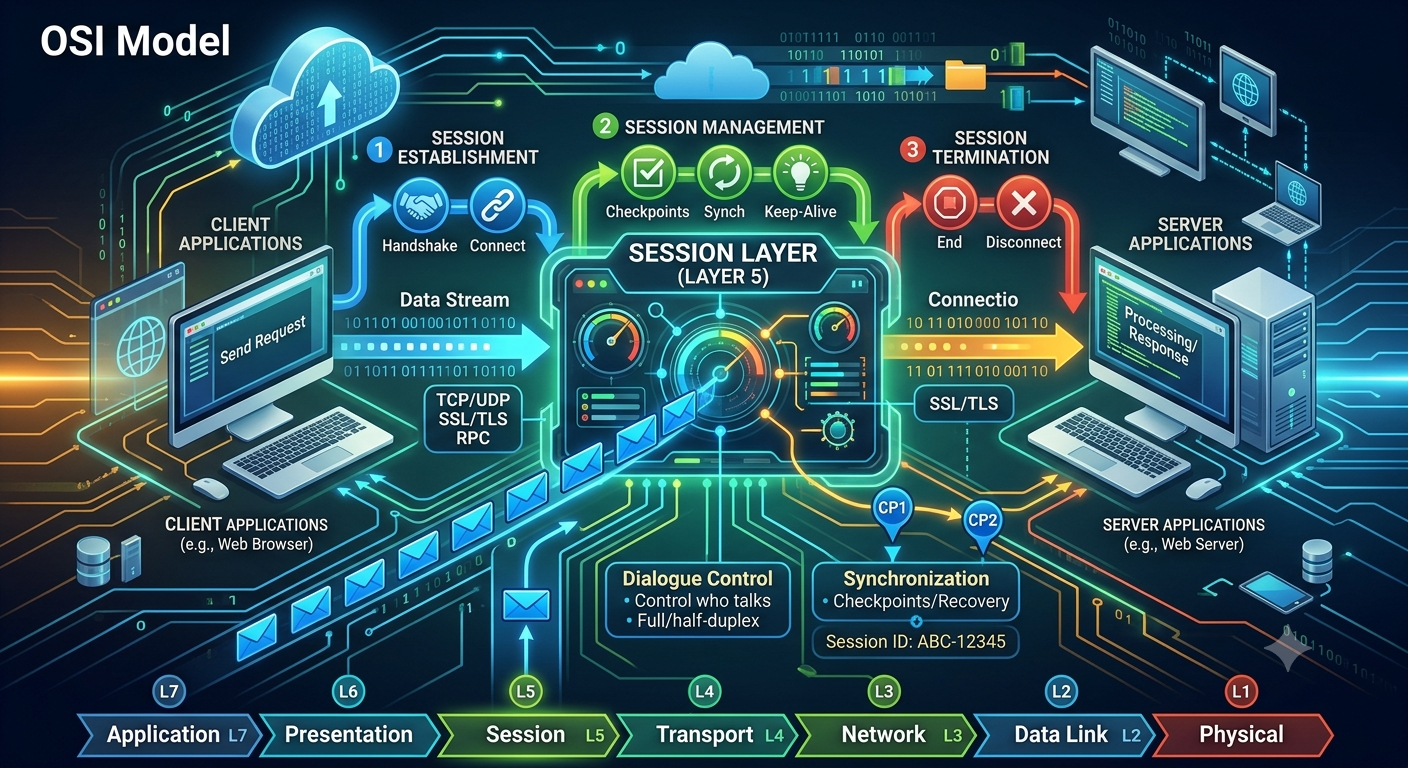
The Session Layer Is The fifth Layer Of The OSI (Open Systems Interconnection) Model. It Is Positioned Between The Presentation Layer (Layer 6) And The Transport Layer (Layer 4). The Primary Responsibility Of The Session Layer Is To Establish, Manage, Synchronize, And Terminate Communication Sessions Between Applications Running On Different Networked Systems. While The Transport Layer Focuses Mainly On End-to-end Data Delivery, The Session Layer Provides Mechanisms For Controlling The Logical Conversation Between Applications.
Position In The OSI Model
The OSI Model Consists Of Seven Layers: Physical, Data Link, Network, Transport, Session, Presentation, And Application. The Session Layer Is Layer 5 And Occupies An Important Position Between Communication-oriented And Application-oriented Functions. It Receives Services From The Transport Layer And Provides Session-management Services To The Presentation Layer. This Separation Helps Network Designers Organize Communication Responsibilities Into Well-defined Functional Layers.
Meaning Of A Session
A session Is A Logical Communication Relationship Established Between Two Applications Or Systems. For Example, When A Client Application Communicates With A Server Application, The Communication May Involve Establishing A Session, Exchanging Information, Synchronizing Activities, And Eventually Terminating The Connection. A Session Provides A Structured Context In Which Multiple Messages Can Be Exchanged Between Communicating Applications.
Main Objective Of The Session Layer
The Main Objective Of The Session Layer Is To Provide dialogue Management And Synchronization Between Applications. It Determines How Communication Takes Place And Helps Maintain The State Of An Ongoing Interaction. If An Application Performs A Long Transaction, The Session Layer Can Provide Synchronization Points So That Communication Can Potentially Resume From A Known Point After An Interruption.
Session Establishment
One Of The Fundamental Functions Associated With The Session Layer Is session Establishment. Before Two Applications Communicate Through A Managed Session, Certain Parameters And Communication Requirements May Need To Be Established. These May Include Authentication-related Coordination, Dialogue Characteristics, Synchronization Requirements, And Session Parameters. After These Parameters Are Established, Applications Can Begin Exchanging Data.
Session Maintenance
After A Session Has Been Established, It Must Be Maintained During Communication. Session Management Involves Keeping Track Of The Logical State Of The Conversation. The Session Layer Conceptually Manages Information Such As Whether A Session Is Active, Whether Communication Is Occurring In A Particular Direction, And Whether Synchronization Points Have Been Established. This Is Particularly Useful For Long-running Application Interactions.
Session Termination
The Session Layer Also Provides Mechanisms For session Termination. When Applications Have Completed Their Communication, The Session Can Be Closed In An Organized Manner. Proper Termination Helps Ensure That Resources Associated With The Communication Are Released And That Both Sides Understand That The Logical Conversation Has Ended.
Dialogue Control
Dialogue Control Is Another Important Responsibility Of The Session Layer. During Communication, Two Applications May Need To Coordinate Which Side Is Allowed To Transmit Data. The Session Layer Conceptually Supports Different Dialogue Modes, Including simplex, Half-duplex, And Full-duplex Communication. Dialogue Control Helps Applications Coordinate Their Communication Behavior.
Simplex Communication
In Simplex Communication, Information Travels In Only One Direction. One System Acts As The Sender And Another As The Receiver. Traditional Examples Include Certain Broadcasting Systems. Although Modern Network Applications Commonly Use Bidirectional Communication, Simplex Communication Provides A Useful Conceptual Example Of Dialogue Management.
Half-Duplex Communication
In half-duplex Communication, Both Parties Can Transmit Information, But Not Necessarily At The Same Time. One Side Transmits While The Other Side Receives, And Then The Direction Can Change. The Session Layer's Dialogue-control Concepts Can Help Coordinate This Type Of Communication So That Both Participants Understand The Current Communication Direction.
Full-Duplex Communication
In full-duplex Communication, Both Sides Can Transmit And Receive Data Simultaneously. Many Modern Application Protocols Operate In A Full-duplex Manner. For Example, Interactive Communication Applications May Continuously Exchange Information In Both Directions. Session Management Concepts Can Help Maintain The Logical Relationship Between The Participating Applications.
Session Synchronization
Synchronization Is One Of The Most Important Concepts Associated With The Session Layer. During A Long Communication Session, Synchronization Points Or Checkpoints Can Be Established. These Points Divide Communication Into Manageable Portions. If A Failure Occurs, The Application May Be Able To Resume Processing From A Synchronization Point Rather Than Restarting The Entire Operation.
Checkpointing
Checkpointing Is Closely Related To Synchronization. Imagine That A Large File Transfer Or Distributed Transaction Consists Of Several Stages. A Checkpoint Can Represent A Successfully Completed Stage. If Communication Is Interrupted After Several Checkpoints Have Been Completed, Recovery Mechanisms Can Potentially Use The Last Successful Checkpoint As A Reference Point.
Recovery From Communication Failure
Network Communication Can Be Interrupted Because Of Connection Failures, System Crashes, Application Errors, Or Other Problems. Session-management Mechanisms Can Support Recovery By Maintaining Logical Synchronization Information. Instead Of Treating An Entire Operation As One Indivisible Activity, Communication Can Be Divided Into Smaller Synchronized Sections.
Token Management
Another Concept Associated With The Session Layer Is token Management. A Token Can Be Considered A Logical Permission That Determines Which Participant Has The Right To Perform A Particular Operation. Token Management Can Help Prevent Simultaneous Conflicting Operations In Situations Where Only One Participant Should Perform A Specific Action At A Time.
Importance Of Token Control
Token Control Is Particularly Useful When Multiple Participants Need Coordinated Access To Shared Resources. For Example, Imagine A Distributed Application In Which Only One System Should Modify A Particular Shared Object At A Time. A Logical Token Can Represent Permission To Perform That Operation. When The Operation Is Complete, The Permission Can Be Transferred To Another Participant.
Session Layer And Transport Layer
The Session Layer And Transport Layer Perform Different Conceptual Functions. The Transport Layer Focuses On End-to-end Delivery Services Such As Reliability, Segmentation, Flow Control, And Transport Connections. The Session Layer, On The Other Hand, Focuses On The Logical Organization And Management Of Conversations Between Applications. Therefore, A Transport Connection And An Application Session Should Not Automatically Be Considered The Same Thing.
Session Layer And Presentation Layer
The Session Layer Is Located Directly Below The Presentation Layer. The Presentation Layer Is Responsible For Aspects Such As Data Representation, Encoding, Encryption-related Transformations, And Compression. The Session Layer Provides Mechanisms For Managing The Logical Interaction In Which That Data Is Exchanged. These Two Layers Therefore Address Different Aspects Of Application Communication.
Session Layer And Application Layer
The Application Layer Is The Top Layer Of The OSI Model And Provides Network Services To Applications. Examples Of Application-level Services Include File Transfer, Email, Web Communication, And Name Services. The Session Layer Supports These Applications By Providing Communication-session Management Concepts. In Actual Internet Protocols, These Responsibilities Are Often Implemented Together Rather Than As A Distinct Standalone Layer.
Session Layer Services
The Major Services Traditionally Associated With The Session Layer Include session Establishment, Session Maintenance, Session Termination, Dialogue Control, Synchronization, Checkpointing, Token Management, And Recovery Support. These Services Allow Applications To Organize Complex Communication Into Structured Interactions.
Session Establishment Process
A Simplified Session Establishment Process Can Be Represented As:
Application A → Session Request → Application B
Application B Responds To The Request, And The Session Parameters Are Negotiated Or Established. Once Both Sides Are Ready, The Data-exchange Phase Begins.
A Conceptual Sequence Is:
Request → Response → Session Established → Data Exchange → Session Termination
The Exact Mechanisms Depend On The Protocols Being Used.
Data Exchange During A Session
Once A Session Has Been Established, Applications Can Exchange Information. The Session Layer Conceptually Maintains The Logical Relationship Between The Communicating Participants. Data Passes Through The Presentation And Lower Layers, Where It Is Transformed And Transmitted Across The Network. At The Receiving System, The Data Travels Upward Toward The Application.
Synchronization Example
Consider A System Transferring A Very Large Dataset. Suppose The Transfer Is Divided Into Several Sections:
Section 1 → Checkpoint 1 → Section 2 → Checkpoint 2 → Section 3 → Checkpoint 3
If An Interruption Occurs During Section 4, A Recovery Mechanism Could Use The Latest Checkpoint As A Reference. This Approach Can Reduce The Amount Of Work That Must Be Repeated.
Session Layer In Distributed Systems
Session-management Concepts Are Especially Important In distributed Systems, Where Multiple Computers Cooperate To Perform A Task. Distributed Applications Often Require Coordination, State Management, Synchronization, And Recovery. Session-oriented Mechanisms Can Provide A Conceptual Framework For Managing These Interactions.
Session Layer In Client-Server Communication
In A Client-server Architecture, A Client Sends Requests To A Server And Receives Responses. A Logical Session Can Represent The Period During Which The Client And Server Interact. For Example, A User May Authenticate To A Server, Perform Several Operations, And Eventually Log Out. The Complete Interaction Can Be Treated As An Application Session.
Session Layer And Web Applications
Modern Web Applications Frequently Use Concepts Such As HTTP Sessions, Cookies, Authentication Tokens, And Server-side Session State. These Are Not Necessarily Implementations Of The OSI Session Layer As Originally Specified. Instead, They Are Application-level Mechanisms That Provide Similar Session-management Functionality Within Internet Architectures.
For Example, An Online Shopping Application May Maintain A User's Session While The User Moves Between Product Pages, Adds Products To A Cart, And Completes Checkout.
Session Management In Web Applications
A Web Application May Assign A Unique Session Identifier To A Client. The Identifier Can Be Stored In A Cookie Or Another Mechanism And Used By The Server To Associate Multiple Requests With The Same Logical Interaction. This Illustrates How Session Management Can Exist At The Application Level Even Though Modern TCP/IP Networking Does Not Strictly Implement The OSI Session Layer As An Independent Protocol Layer.
Session Layer And Authentication
Authentication Itself Is Generally Associated With Higher-level Security Mechanisms Rather Than Being Exclusively A Session Layer Function. However, Session Establishment Can Involve Coordination Related To Authentication. For Example, An Application May Establish An Authenticated Session After Verifying User Credentials Or Cryptographic Authentication Data.
Session Layer And Security
The Session Layer Is Not Primarily A Security Layer. Encryption, Integrity Protection, And Authentication Are Generally Implemented Using Mechanisms Associated With The Presentation Layer, Application Layer, Transport Layer, Or Dedicated Security Protocols. Nevertheless, Session Management Is Closely Related To Security Because Applications Often Need To Establish, Maintain, Expire, And Terminate Authenticated Sessions.
Session Timeout
Session Timeout Is A Common Concept In Modern Applications. If A User Remains Inactive For A Predefined Period, The Application May Terminate The Session. This Reduces The Risk Associated With Abandoned Authenticated Sessions. Session Expiration Can Be Implemented By The Application Rather Than By A Dedicated OSI Layer 5 Protocol.
Session Layer Protocols
The Original OSI Architecture Included Session-oriented Protocols And Services Designed To Provide Standardized Session Management. However, The Modern Internet Protocol Suite Generally Does Not Contain A Separately Implemented Session Layer Corresponding Directly To OSI Layer 5. Instead, Session-related Functions Are Distributed Among Protocols And Applications.
Examples Of Session-Oriented Technologies
Technologies That Demonstrate Session-management Concepts Include RPC Mechanisms, SMB Sessions, NetBIOS Session Services, SIP Dialogs, HTTP Sessions, WebSocket Connections, And Various Application-level Authentication Sessions. These Technologies Do Not All Belong Formally To OSI Layer 5, But They Demonstrate Functions That Resemble Session Establishment, Maintenance, Synchronization, Or Termination.
Session Layer In Remote Procedure Calls
Remote Procedure Call (RPC) Allows One Application To Invoke An Operation On Another Computer As Though It Were A Local Procedure. A Logical Interaction May Be Maintained Between The Client And Server While Operations Are Performed. Session-management Concepts Can Help Organize These Distributed Interactions, Although Specific RPC Implementations Distribute Functionality Across Multiple Protocol Layers.
Session Layer In Communication Systems
In Communication Systems, A Logical Session Can Provide Continuity Across Multiple Exchanges. Instead Of Treating Every Message As Completely Independent, The Participating Systems Can Understand That Messages Belong To A Larger Interaction. This Is Particularly Useful For Transactions, Authentication, Collaborative Applications, And Distributed Processing.
Advantages Of The Session Layer
The Session Layer Provides Several Conceptual Advantages:
-
It Organizes Application Communication Into Sessions.
-
It Supports Dialogue Control.
-
It Provides Synchronization Mechanisms.
-
It Can Support Checkpoint-based Recovery.
-
It Provides Mechanisms For Orderly Session Establishment And Termination.
-
It Can Coordinate Access Using Token Mechanisms.
-
It Separates Session-management Responsibilities From Data Representation And Transport.
Disadvantages And Limitations
The OSI Session Layer Also Has Limitations In Modern Networking. Modern TCP/IP Implementations Generally Do Not Maintain A Separate Session Layer. Session-management Functions Are Often Implemented Inside Applications, Libraries, Middleware, Or Other Protocols. This Can Lead To Duplicated Functionality And Makes It Difficult To Identify A Single Protocol As The Universal Layer 5 Implementation.
Session Layer Vs TCP/IP Model
The OSI Model Contains Seven Distinct Layers, While The TCP/IP Model Traditionally Uses Fewer Layers. The TCP/IP Application Layer Encompasses Functionality Corresponding To Several OSI Layers, Particularly The Session, Presentation, And Application Layers. Consequently, Many Modern Protocols Implement Session-related Functionality At The Application Level Rather Than Through A Separate Session Layer Protocol.
Importance In Modern Networking
Although The Session Layer Is Not Normally Visible As An Independent Protocol Layer In Modern Internet Networking, Its Concepts Remain Important. Developers Frequently Need To Manage Sessions, Authentication States, Connection Lifetimes, Synchronization, Reconnection, And Recovery. Understanding Layer 5 Therefore Helps Students Understand How Complex Application Communication Is Organized.
Real-World Example
Consider An Online Banking Application. A User Logs In, Establishes An Authenticated Interaction, Checks An Account Balance, Transfers Money, Receives Confirmation, And Logs Out. The Complete Interaction Represents A Logical Application Session. Session-management Mechanisms Can Maintain The State Of This Interaction, Enforce Expiration, Coordinate Requests, And Terminate The Session When The User Logs Out.
The Simplified Architecture Can Be Represented As:
+--------------------------------------+
|       Application Layer              |
|   Web / Email / File Applications    |
+--------------------------------------+
|       Presentation Layer             |
| Encoding / Compression / Formatting  |
+--------------------------------------+
|          Session Layer               |
| Establish | Manage | Synchronize     |
| Dialogue  | Recover | Terminate      |
+--------------------------------------+
|          Transport Layer             |
| TCP / UDP / Reliable Delivery        |
+--------------------------------------+
|           Network Layer              |
| IP / Routing / Logical Addressing    |
+--------------------------------------+
|         Data Link Layer              |
| Frames / MAC / Error Detection       |
+--------------------------------------+
|          Physical Layer              |
| Signals / Cables / Radio             |
+--------------------------------------+
Conclusion
The Session Layer (Layer 5) Of The OSI Model Is Responsible For Managing Logical Communication Sessions Between Applications. Its Major Concepts Include session Establishment, Dialogue Control, Synchronization, Checkpointing, Token Management, Session Recovery, And Session Termination. It Provides An Important Conceptual Bridge Between Application Requirements And Lower-level Transport Services.
Although Modern TCP/IP Networks Generally Do Not Implement The Session Layer As An Independent Layer, Its Functions Remain Highly Relevant In Contemporary Software Systems. Web Sessions, Authentication Sessions, RPC Interactions, Persistent Application Connections, Distributed Systems, And Synchronization Mechanisms All Demonstrate The Continuing Importance Of Session Management. Therefore, Understanding The Session Layer Is Valuable For Students And Professionals Studying computer Networks, Cybersecurity, Distributed Systems, Cloud Computing, And Network Application Development.
Tags:
Session Layer In The OSI Model, Meaning Of A Session, Position In The OSI Model, Session Establishment