What Is RPC (Remote Procedure Call) In The Session Layer?
Category: NETWORKING | 23rd September 2026, Wednesday
Introduction To RPC
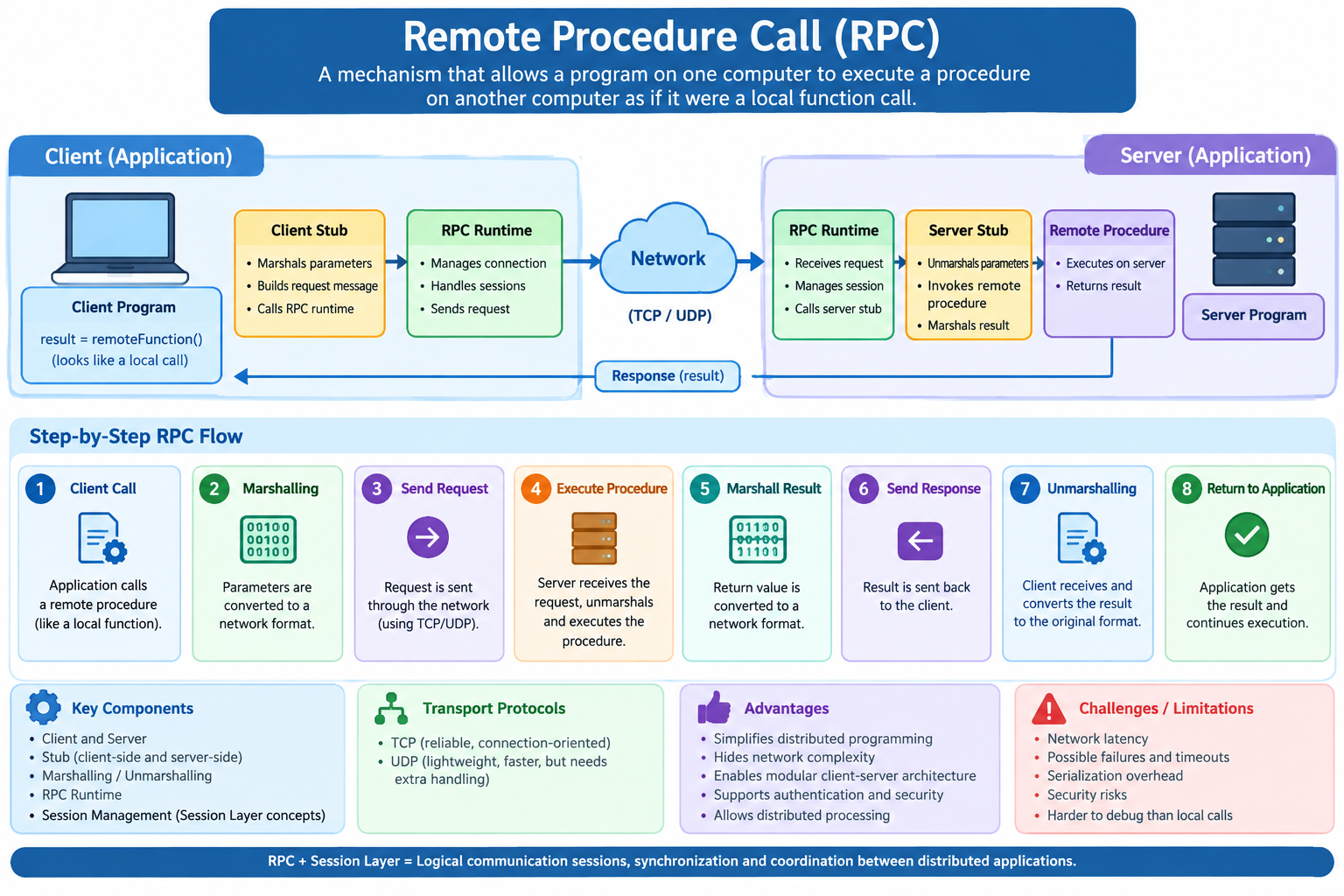
Remote Procedure Call (RPC) Is A Communication Mechanism That Allows A Program On One Computer To Execute A Procedure Or Function On Another Computer As Though The Procedure Were A Local Function Call. RPC Hides Many Networking Details From The Application Developer. Instead Of Manually Creating Connections, Formatting Messages, Sending Requests, Receiving Responses, And Handling Network Communication, The Developer Can Invoke A Remote Operation Using A Procedure-like Interface. RPC Is Therefore An Important Concept In Distributed Computing And Client-server Communication.
RPC And The OSI Session Layer
RPC Is Often Discussed In Relation To The Session Layer (Layer 5) Of The OSI Model Because It Establishes And Manages Logical Communication Sessions Between Distributed Applications. The Session Layer Is Responsible For Establishing, Maintaining, Synchronizing, And Terminating Communication Sessions. RPC Itself Is Not Formally An OSI Session Layer Protocol In The Same Strict Sense As Protocols Such As NetBIOS Session Service. Rather, RPC Is A Distributed-computing Mechanism That Can Use Session-oriented Communication Services Provided By Lower Layers.
Purpose Of RPC
The Primary Purpose Of RPC Is To Make Communication Between Distributed Applications Easier. In A Conventional Local Function Call, A Program Passes Parameters To A Function And Receives A Return Value. With RPC, The Function May Actually Execute On A Remote Server. The RPC Framework Handles The Conversion Of Parameters Into Network Messages, Transmission Of Those Messages, Execution Of The Remote Procedure, And Delivery Of The Result Back To The Client.
Client And Server Architecture
RPC Normally Follows A Client-server Architecture. The client Is The Application Requesting A Service, While The server Provides The Remote Procedure. For Example, A Client Application May Request A Remote Database Operation, Authentication Service, File Operation, Or Computational Task. The Server Receives The Request, Executes The Appropriate Procedure, And Returns The Result. This Architecture Enables Applications To Distribute Processing Across Multiple Computers.
RPC Session Establishment
Before Remote Procedures Can Be Executed, Communication Between The Client And Server May Need To Be Established. Depending On The RPC Implementation And Underlying Transport Protocol, This Can Involve Creating A Connection, Negotiating Communication Parameters, Authenticating Participants, And Establishing Session State. Session Management Is Particularly Important When Multiple Operations Need To Occur Within A Logical Communication Context.
RPC As A Logical Communication Mechanism
RPC Creates The Abstraction Of A Logical Conversation Between Applications. The Client Does Not Necessarily Need To Know The Physical Location Or Networking Details Of The Remote Procedure. Instead, It Uses An Interface Representing The Remote Service. This Abstraction Is One Of The Most Important Advantages Of RPC Because It Separates Application Logic From Many Networking Operations.
How An RPC Request Works?
An RPC Request Generally Begins When The Client Calls A Remote Function. The RPC System Identifies The Target Server And Procedure, Collects The Function Parameters, Converts Them Into A Suitable Network Representation, And Creates A Request Message. The Message Is Transmitted Through The Underlying Network Stack. The Server Receives The Request, Reconstructs The Parameters, Invokes The Appropriate Procedure, And Generates A Response.
RPC Stub
A Major Component Of Traditional RPC Systems Is The stub. A Client-side Stub Behaves Like A Local Representation Of The Remote Procedure. When The Application Calls The Stub, The Stub Packages The Procedure Name And Parameters Into A Request. The Server-side Stub Receives The Request And Converts The Transmitted Information Back Into Arguments That Can Be Passed To The Actual Server Procedure.
Marshalling In RPC
The Process Of Converting Procedure Parameters Into A Network-transmittable Format Is Called marshalling Or Serialization. For Example, An Integer, String, Array, Structure, Or Object May Need To Be Converted Into A Sequence Of Bytes. Marshalling Ensures That Complex Application Data Can Travel Through A Network. The Server Performs The Corresponding Unmarshalling Operation To Reconstruct The Original Parameters.
Unmarshalling
Unmarshalling Is The Reverse Process Of Marshalling. After The Server Receives An RPC Request, It Interprets The Encoded Data And Reconstructs The Parameters Required By The Remote Procedure. Once The Procedure Finishes, Its Return Values Are Similarly Marshalled Into A Response Message. The Client Then Unmarshals That Response And Provides The Result To The Application.
RPC Communication Flow
A Simplified RPC Communication Sequence Is: The Client Calls A Local-looking Function, The Client Stub Marshals Parameters, The RPC Runtime Sends A Request, The Server Runtime Receives It, The Server Stub Unmarshals The Parameters, The Remote Procedure Executes, The Server Marshals The Result, The Response Travels Back To The Client, And The Client Stub Unmarshals The Result. The Application Can Then Continue Execution Using The Returned Value.
Role Of The Session Layer
The Session Layer Provides Concepts That Are Useful For RPC Communication, Including Session Establishment, Session Maintenance, Synchronization, And Termination. In A Distributed Application, A Logical Session Can Represent An Ongoing Interaction Between Client And Server. The Session Can Maintain Communication Context And Help Applications Coordinate Multiple Related Operations.
Session Synchronization
Synchronization Is Particularly Important In Long-running RPC-based Communication. If A Session Involves Multiple Operations, Synchronization Points Can Help Applications Recover From Interruptions. For Example, A Distributed Application Performing Several Stages Of Processing May Periodically Establish Checkpoints. If Communication Fails, The System May Be Able To Resume From An Appropriate Synchronization Point Instead Of Restarting The Entire Operation.
RPC And Transport Protocols
RPC Does Not Necessarily Operate Directly On The Session Layer. Modern RPC Implementations Commonly Use Transport Protocols Such As TCP Or UDP, Depending On The Implementation And Application Requirements. TCP Provides Reliable Connection-oriented Communication, While UDP Provides Lightweight Datagram Communication. The RPC Framework Uses These Transport Capabilities To Exchange Requests And Responses.
RPC Over TCP
When RPC Uses TCP, The Communication Generally Benefits From TCP's Reliable, Ordered Byte Stream. Lost Packets Are Retransmitted, And Data Is Delivered In Order. This Can Simplify RPC Implementations That Require Reliable Request And Response Delivery. However, TCP Introduces Connection-management Overhead And May Not Be Appropriate For Every Distributed Application.
RPC Over UDP
RPC Can Also Operate Over UDP In Implementations Where Low Overhead Is Important. UDP Does Not Itself Guarantee Delivery, Ordering, Or Duplicate Prevention. Therefore, An RPC Framework Using UDP May Need To Implement Additional Mechanisms Such As Request Identifiers, Retransmission, Timeout Handling, And Duplicate Detection. This Approach Can Be Useful When Applications Require Lightweight Communication.
RPC And Transparency
One Of The Major Goals Of RPC Is location Transparency. Ideally, An Application Should Be Able To Invoke A Remote Service Without Needing To Understand All The Details Of Where The Service Is Running. The RPC Runtime Can Locate The Appropriate Server And Communicate With It. However, RPC Cannot Completely Hide Network Behavior Because Remote Operations Can Fail Due To Connectivity Problems, Server Failures, Timeouts, Or Authentication Issues.
RPC Name And Service Discovery
A Client Needs To Identify The Remote Procedure It Wants To Invoke. RPC Systems May Use Service Registries, Program Numbers, Interfaces, Endpoints, Ports, Or Other Identifiers. A Service-discovery Mechanism Can Help Clients Determine Where A Particular RPC Service Is Available. This Is Especially Important In Distributed Environments Where Servers Can Change Addresses Or Multiple Service Instances May Exist.
RPC Authentication
Security Is An Important Aspect Of RPC. A Remote Server Should Verify That The Client Is Authorized To Invoke A Particular Procedure. RPC Systems Can Use Authentication Mechanisms Involving Usernames, Passwords, Cryptographic Credentials, Security Tokens, Certificates, Or Other Identity Mechanisms. Authentication Helps Prevent Unauthorized Users Or Applications From Accessing Remote Services.
RPC Authorization
Authentication Determines who Is Communicating, While Authorization Determines what That Entity Is Allowed To Do. An RPC Server May Allow One Client To Execute Certain Procedures While Denying Access To Sensitive Operations. For Example, A Normal User Might Be Permitted To Retrieve Information But Not Modify Administrative Configuration. Proper Authorization Is Therefore Essential For Secure RPC Systems.
RPC And Error Handling
Network Communication Introduces Errors That Do Not Normally Occur With Local Function Calls. A Remote Server May Become Unavailable, The Network May Fail, Or A Request May Exceed A Timeout Period. RPC Frameworks Therefore Need Mechanisms For Detecting And Reporting Failures. The Client Should Distinguish Between An Application-level Error Returned By The Server And A Communication-level Failure.
RPC Timeouts
A Timeout Specifies How Long A Client Should Wait For A Response. If A Server Does Not Respond Within The Expected Period, The Client May Consider The Operation Unsuccessful. Timeout Management Is Essential Because A Permanently Blocked Client Would Be Undesirable In A Distributed System. Appropriate Timeout Values Depend On Network Conditions And Application Requirements.
RPC Retransmission
If A Request Or Response Is Lost, An RPC Framework May Retransmit The Request. Retransmission Is Straightforward When The Remote Procedure Is idempotent, Meaning That Executing It Multiple Times Produces The Same Effective Result. For Example, Reading Information Is Generally Easier To Retry Than Performing A Financial Transaction Or Creating A New Database Record.
Duplicate Requests
Retransmission Can Create Duplicate Requests. Suppose The Server Receives A Request And Successfully Executes It, But The Response Is Lost. The Client May Retransmit The Same Request. If The Operation Is Not Idempotent, Executing It Again Could Cause An Unintended Result. RPC Systems May Therefore Use Request Identifiers, Sequence Numbers, Duplicate Detection, Or Server-side State To Handle This Problem.
RPC State Management
RPC Communication Can Be Either Relatively Stateless Or Stateful. In Stateless RPC, Each Request Contains Enough Information For The Server To Process It Independently. In Stateful RPC, The Server Maintains Information About An Ongoing Client Session. Stateful Communication Can Be Useful For Complex Multi-step Operations But Requires Careful Session Management And Recovery Mechanisms.
RPC And Distributed Computing
RPC Is A Fundamental Concept In Distributed Computing Because It Allows Software Components Running On Different Machines To Cooperate. Instead Of Placing All Application Functionality On One Computer, Developers Can Divide An Application Into Services. A Client Can Invoke Procedures Offered By Remote Services, Allowing Computing Resources And Application Responsibilities To Be Distributed.
RPC In Distributed Databases
Distributed Database Systems Can Use RPC-style Communication For Operations Between Database Components. For Example, One Server May Request Information From Another Server Or Ask A Remote Component To Perform A Transaction-related Operation. RPC Provides A Structured Interface Through Which These Distributed Components Can Communicate.
RPC In Operating Systems
Operating Systems And System Software Can Use RPC Mechanisms To Communicate Between Processes Or Machines. Remote Services May Provide Authentication, File Management, Directory Services, Configuration Operations, Or Resource-management Functions. RPC Allows These Services To Expose Defined Interfaces Rather Than Requiring Every Client To Implement Low-level Communication Mechanisms.
RPC And Microservices
Modern Microservice Architectures Frequently Use RPC-style Communication. A Microservice Exposes Operations That Other Services Can Invoke Remotely. Technologies Such As gRPC Provide Strongly Typed RPC Interfaces Using Modern Serialization Mechanisms. In A Microservice Environment, RPC Can Provide Efficient Communication Between Internal Services While Clearly Defining Service Interfaces.
gRPC As A Modern RPC Framework
gRPC Is A Modern High-performance RPC Framework Originally Developed At Google And Now Maintained As An Open-source Project. It Commonly Uses HTTP/2 For Transport And Protocol Buffers For Interface And Message Definitions. Developers Define Services And Procedures In An Interface Description, And Tooling Can Generate Client And Server Code. GRPC Demonstrates How Traditional RPC Concepts Have Evolved For Modern Distributed Systems.
RPC Interface Definition
An RPC Interface Specifies Which Procedures Are Available And What Parameters And Results They Use. A Well-designed Interface Provides A Clear Contract Between Client And Server. Interface Definitions Can Also Support Automatic Code Generation, Reducing Programming Errors And Ensuring That Different Components Follow A Common Communication Specification.
RPC Advantages
RPC Has Several Advantages. It Simplifies Distributed Programming By Providing A Function-call Abstraction. It Can Reduce Networking Complexity For Application Developers. It Supports Modular Client-server Architectures, Enables Distributed Processing, And Can Provide Strongly Defined Interfaces. RPC Frameworks Can Also Automatically Handle Serialization, Connection Management, Authentication, Error Handling, And Other Communication Tasks.
RPC Disadvantages
RPC Also Has Limitations. A Remote Procedure Call Is Not Equivalent To A Local Function Call Because Network Communication Introduces Latency And Failures. Serialization And Deserialization Create Overhead. Network Congestion Can Affect Performance. Services May Become Unavailable, And Debugging Distributed Calls Can Be More Complicated Than Debugging Local Function Calls. Developers Must Therefore Understand The Distributed Nature Of RPC.
RPC Performance Considerations
RPC Performance Depends On Network Latency, Message Size, Serialization Format, Transport Protocol, Server Processing Time, And The Number Of Requests. Sending Many Small RPC Requests Can Produce Significant Communication Overhead. Applications Can Improve Performance By Combining Operations, Reducing Unnecessary Network Calls, Using Efficient Serialization, Maintaining Appropriate Connections, And Designing Efficient Service Interfaces.
RPC And Session Termination
After Communication Is Complete, A Session May Need To Be Terminated. Proper Session Termination Releases Network Resources, Memory, Authentication Contexts, And Other State. In Connection-oriented Systems, Closing The Connection Is Particularly Important. Applications Should Also Handle Abnormal Termination, Such As A Server Crash Or Unexpected Network Failure.
RPC Security Risks
RPC Systems Can Face Several Security Risks. Attackers May Attempt Unauthorized Procedure Calls, Intercept Communications, Replay Requests, Exploit Vulnerable Server Procedures, Or Overload Services With Excessive Requests. Poorly Designed RPC Interfaces Can Expose Sensitive Functionality. Encryption, Authentication, Authorization, Input Validation, Rate Limiting, Logging, And Secure Configuration Are Therefore Important Security Controls.
RPC And Encryption
Sensitive RPC Communication Should Generally Be Protected Against Unauthorized Observation And Modification. Depending On The Framework, Encryption Can Be Provided Through Technologies Such As TLS. Encryption Protects Data While It Travels Across The Network And Helps Prevent Attackers From Reading Or Modifying RPC Requests And Responses.
RPC Applications
RPC Has Applications In Many Areas, Including Distributed Databases, Cloud Computing, Enterprise Applications, Operating-system Services, File Systems, Authentication Systems, Network Management, Microservices, Scientific Computing, And Large-scale Distributed Platforms. Whenever Software Components Need To Request Operations From Another Process Or Computer, An RPC-style Architecture Can Be Considered.
RPC Compared With Local Procedure Calls
The Syntax And Programming Model Of RPC May Resemble A Local Procedure Call, But Their Behavior Is Fundamentally Different. A Local Function Generally Executes Within The Same Process And Memory Environment. An RPC Crosses A Process Or Network Boundary. Consequently, RPC Involves Serialization, Communication Delay, Possible Network Failure, Authentication, And Server Availability Issues. Good Distributed-system Design Treats These Differences Explicitly.
Conclusion
Remote Procedure Call Is An Important Mechanism For Communication Between Distributed Software Components. It Allows A Client To Request Execution Of A Procedure On A Remote Server Through A Structured Interface. In The Context Of The OSI Model, RPC Is Closely Related To Session Layer Concepts Because It Requires Logical Communication Sessions, Coordination, Synchronization, And Session Management, Although RPC Itself Is Not Strictly An OSI Layer 5 Protocol.
Through Stubs, Marshalling, Service Discovery, Transport Protocols, Authentication, Error Handling, And Session Management, RPC Simplifies Distributed Application Development. Modern Technologies Such As GRPC Have Extended The Traditional RPC Concept For Cloud Computing And Microservice Architectures. At The Same Time, Developers Must Remember That A Remote Call Is Fundamentally Different From A Local Function Call Because Network Latency, Failures, Security Risks, And Distributed State Can Affect Its Behavior.
Tags:
RPC, Remote Procedure Call, RPC Applications, RPC And Encryption, RPC Security Risks, RPC And Session Termination, RPC Advantages