What Is PPTP In The Session Layer: Point-to-Point Tunneling Protocol
Category: NETWORKING | 25th September 2026, Friday
Introduction
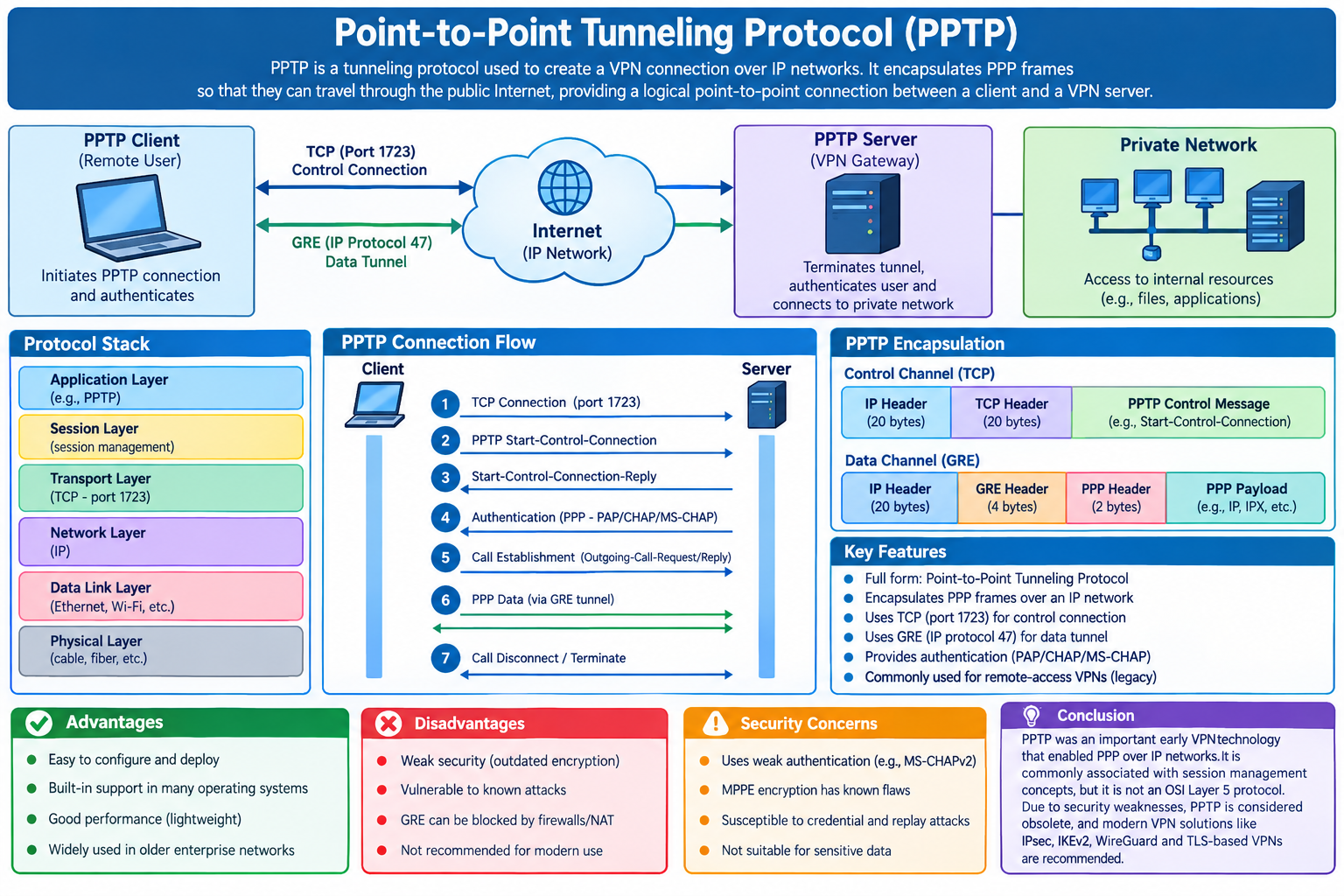
PPTP, Or Point-to-Point Tunneling Protocol, Is A Network Protocol Historically Used To Create Virtual Private Network (VPN) Connections Over IP Networks. It Was Designed To Encapsulate Point-to-Point Protocol (PPP) Packets So That They Could Travel Through An IP-based Network Such As The Internet. PPTP Is Often Discussed In Relation To The Session Layer Because It Establishes And Manages A Logical Communication Session Between A Client And A VPN Server. However, Technically, PPTP Is Not An OSI Layer 5 Protocol. It Operates Across Several Networking Functions And Is Best Understood As A Tunneling And VPN Protocol.
Full Form Of PPTP
The Full Form Of PPTP Is Point-to-Point Tunneling Protocol. The Protocol Was Developed During The 1990s For Creating VPN Connections Over Existing IP Networks. PPTP Enabled Users To Establish A Virtual Point-to-point Connection Between A Remote Computer And A Private Network. It Became Particularly Popular In Early Microsoft Windows Environments Because Operating Systems Provided Built-in PPTP Client And Server Support.
PPTP And The Session Layer
The OSI Session Layer Is Responsible For Establishing, Maintaining, Synchronizing, And Terminating Communication Sessions Between Applications. PPTP Contains Mechanisms That Establish And Maintain A Logical VPN Tunnel, So It Can Be Used As An Example When Teaching Session-oriented Communication. Nevertheless, PPTP Should Not Be Classified Strictly As A Session Layer Protocol. Unlike A Textbook Layer 5 Protocol, PPTP Involves Control Signaling, PPP Encapsulation, GRE Tunneling, And IP Networking.
Purpose Of PPTP
The Main Purpose Of PPTP Was To Allow PPP Frames To Be Transmitted Through An IP Network. A Remote User Could Connect To A VPN Server And Establish A Logical Tunnel Through The Internet To A Private Network. Once The Tunnel Was Established, PPP-based Communication Could Take Place Through It. This Made It Possible For Remote Users To Access Network Resources As Though They Were Connected Through A Virtual Point-to-point Link.
PPTP And VPN
PPTP Is Historically Important In The Development Of Virtual Private Networks. A VPN Creates A Logical Connection Across An Underlying Network Infrastructure. PPTP Provides A Mechanism For Tunneling PPP Traffic Through IP Networks. In A Traditional Deployment, A User Establishes A Connection With A PPTP Server, Authentication Takes Place Using PPP Mechanisms, And PPP Frames Are Subsequently Transported Through The Tunnel.
Basic PPTP Architecture
A PPTP System Generally Consists Of A PPTP Client And A PPTP Server. The Client May Be A Desktop Computer, Laptop, Or Another Network Device. The Server Receives PPTP Control Messages And Processes The Tunneled PPP Traffic. Between The Client And Server Is An IP Network, Which May Be The Public Internet. The Architecture Creates A Logical Point-to-point Relationship Across That Underlying Network.
PPTP Client
The PPTP Client Is The Endpoint That Initiates The VPN Connection. It Establishes Communication With The PPTP Server And Requests Creation Of A Tunnel. The Client Can Then Transmit PPP Frames Through The Established Tunnel. Historically, PPTP Clients Were Integrated Into Operating Systems, Making The Technology Relatively Easy To Deploy For Remote-access VPNs.
PPTP Server
The PPTP Server Accepts Connection Requests From PPTP Clients. It Establishes The Control Relationship, Manages The Tunnel, And Processes The Encapsulated PPP Traffic. The Server May Be Connected To A Private Organizational Network, Allowing Authenticated Remote Users To Communicate With Internal Resources. In Older Enterprise Networks, PPTP Servers Were Commonly Used For Remote Employee Access.
PPTP Control Connection
PPTP Uses A Separate TCP Control Connection To Manage The Tunnel. Traditionally, The PPTP Control Channel Uses TCP Port 1723. The Control Connection Is Responsible For Exchanging Messages Related To Tunnel Establishment, Call Management, And Termination. This Separation Between Control Signaling And Tunneled Data Is An Important Characteristic Of PPTP.
PPTP Data Channel
PPTP Carries PPP Data Through A Separate Mechanism Based On GRE (Generic Routing Encapsulation). Unlike The TCP Control Connection, The Data Channel Does Not Normally Use A TCP Or UDP Port. Instead, PPTP Encapsulates PPP Frames Inside GRE Packets. This Distinction Is Important When Configuring Firewalls Because Allowing TCP Port 1723 Alone Is Not Sufficient For Complete PPTP Operation.
GRE In PPTP
Generic Routing Encapsulation, Or GRE, Provides The Tunneling Mechanism Used By PPTP. GRE Allows One Network Protocol Packet To Be Encapsulated Within Another Network Protocol. In PPTP, PPP Frames Are Encapsulated And Transported Using GRE Over IP. Therefore, PPTP Can Be Understood As A Combination Of A TCP-based Control Mechanism And GRE-based Data Tunneling.
PPP And PPTP
PPTP Relies Heavily On Point-to-Point Protocol (PPP). PPP Was Designed For Transmitting Network-layer Packets Over Point-to-point Communication Links. PPTP Essentially Allows PPP Frames To Travel Through An IP-based Network. PPP Also Provides Mechanisms For Authentication And Configuration, Which Historically Made It Useful For Remote-access VPN Systems.
Establishing A PPTP Session
A Simplified PPTP Connection Begins When The Client Establishes A TCP Connection With The Server On Port 1723. The Client And Server Exchange PPTP Control Messages To Establish The Necessary Tunnel And Call State. Once The Tunnel Is Ready, PPP Communication Can Be Carried Through GRE. The Client Can Then Communicate With Resources Available Through The VPN Connection.
PPTP Session Management
Session Management Is One Reason PPTP Can Be Discussed Alongside Session Layer Concepts. The Protocol Establishes A Logical Communication Relationship, Maintains Tunnel State, Manages Calls, And Provides Procedures For Closing The Connection. Control Messages Allow The Client And Server To Coordinate The Lifecycle Of The Tunnel. These Functions Resemble The Broader Session-management Responsibilities Defined By The OSI Model.
PPTP Control Messages
PPTP Defines Control Messages For Managing The Tunnel And Calls. These Messages Allow Endpoints To Establish Communication, Exchange Information, Manage Calls, And Terminate Connections. Examples Include Start-Control-Connection, Start-Control-Connection-Reply, Outgoing-Call-Request, And Outgoing-Call-Reply. These Messages Provide The Signaling Required To Manage A PPTP Communication Session.
PPTP Call Establishment
A PPTP Tunnel Can Support Call-related Signaling Between The Client And Server. After The Control Connection Is Established, The Client Can Request Creation Of A Logical Call. The Server Responds According To Whether The Request Can Be Accepted. Once The Call Is Established, PPP Frames Can Be Transmitted Through The GRE-based Data Channel.
PPTP Authentication
Authentication In PPTP Is Primarily Associated With The PPP Layer Rather Than PPTP Itself. PPP Historically Supported Authentication Protocols Such As PAP And CHAP, While Microsoft Environments Commonly Used MS-CHAP Variants. Authentication Determines Whether A User Is Permitted To Establish The VPN Connection. However, Authentication Alone Does Not Provide Strong Confidentiality For The Entire VPN Communication.
PPTP Encryption
One Of The Major Historical Security Mechanisms Associated With PPTP Was MPPE, Or Microsoft Point-to-Point Encryption. MPPE Was Commonly Used With PPP-based VPN Connections And Relied On Keys Derived From Authentication Credentials. Although Encryption Was An Important Feature For Its Time, The Overall Security Design Of PPTP Has Serious Weaknesses By Modern Standards.
PPTP Security Problems
PPTP Is Now Considered obsolete And Insecure For Modern VPN Deployments. Security Researchers Have Identified Significant Weaknesses In Its Authentication And Encryption Mechanisms. In Particular, Historical Deployments Using MS-CHAPv2 And MPPE Can Be Vulnerable To Attacks That May Allow Credentials Or Encrypted Traffic To Be Compromised. Consequently, Modern Systems Generally Recommend Stronger VPN Technologies Instead Of PPTP.
PPTP And Confidentiality
Confidentiality Means Preventing Unauthorized Parties From Reading Transmitted Information. PPTP Attempted To Provide Confidentiality Through PPP Encryption Mechanisms Such As MPPE. However, Weaknesses In The Underlying Authentication And Encryption Ecosystem Mean That PPTP Should Not Be Relied Upon To Protect Sensitive Modern Communications. Stronger Protocols Such As IPsec-based VPNs And Modern TLS-based VPN Technologies Are Generally Preferred.
PPTP And Integrity
Data Integrity Ensures That Transmitted Information Has Not Been Improperly Modified. PPTP's Security Architecture Has Limitations In Providing Modern Cryptographic Assurance. The Security Properties Of The Complete Connection Depend On PPP Authentication And Encryption Mechanisms. Because These Mechanisms Have Known Weaknesses, PPTP Does Not Provide The Level Of Integrity Protection Expected From Contemporary Secure VPN Technologies.
PPTP And Authentication
Authentication Is An Important Component Of A VPN Because The Server Must Determine Whether The Connecting User Is Authorized. PPTP Commonly Relied On PPP Authentication Methods. However, Some Historically Common Methods, Particularly MS-CHAPv2, Have Known Cryptographic Weaknesses. Therefore, Organizations Should Not Consider PPTP Authentication Adequate For Modern High-security Environments.
PPTP Through NAT
PPTP Can Encounter Difficulties When Operating Through Network Address Translation (NAT) Devices. This Is Partly Because PPTP Uses GRE For Carrying Data And TCP Port 1723 For Control. NAT And Firewall Devices Must Understand Or Correctly Handle Both Components. Modern Networks May Therefore Require Special Support For PPTP, Whereas Newer VPN Protocols Are Generally Designed With Contemporary Network Environments In Mind.
PPTP Through Firewalls
A Firewall Must Permit The Necessary PPTP Traffic For A Connection To Work. This Normally Includes TCP Port 1723 For The Control Channel And GRE Protocol Traffic For The Tunneled PPP Data. Blocking GRE While Allowing TCP 1723 Can Result In A Situation Where The Control Connection Appears To Work But Actual VPN Data Cannot Pass Successfully. This Makes PPTP Configuration More Complicated In Some Environments.
PPTP Packet Structure
PPTP Communication Involves Several Encapsulation Layers. At The Application/control Level, PPTP Control Messages Are Carried Over TCP. For Data Transmission, PPP Frames Are Encapsulated Within GRE Packets, Which Are Then Carried By IP. At Lower Layers, IP Packets Are Transmitted Through Technologies Such As Ethernet Or Wi-Fi. This Layered Structure Demonstrates How Different Protocols Cooperate To Create A VPN Tunnel.
PPTP Encapsulation
Encapsulation Is The Process Of Placing One Protocol's Data Inside Another Protocol's Packet Structure. In PPTP, A PPP Frame Is Encapsulated Within GRE, While GRE Is Transported Over IP. This Enables PPP-based Communication To Travel Through An IP Network. The Receiving Endpoint Reverses The Process, Removes The Encapsulation, And Processes The Original PPP Frame.
PPTP And OSI Model
From An OSI Perspective, PPTP Demonstrates Interaction Across Multiple Layers Rather Than Belonging Exclusively To One Layer. IP Operates At The Network Layer, TCP Operates At The Transport Layer, GRE Provides Tunneling, And PPP Provides Point-to-point Framing And Authentication Functions. PPTP Control Mechanisms Operate At A Higher Level. Therefore, Describing PPTP Simply As A "Session Layer Protocol" Is An Educational Simplification Rather Than A Precise Protocol Classification.
Advantages Of PPTP
Historically, PPTP Had Several Practical Advantages. It Was Relatively Easy To Configure, Supported By Many Operating Systems, And Required Comparatively Modest Processing Resources. Its Architecture Was Straightforward For Remote-access VPN Applications. PPTP Also Worked Well In Many Older Enterprise Environments And Became Widely Deployed Because Operating-system Vendors Integrated PPTP Support Directly Into Their Networking Software.
Disadvantages Of PPTP
The Disadvantages Of PPTP Are Significant Today. Its Cryptographic Mechanisms Are Outdated, Its Authentication Architecture Has Known Weaknesses, And Its GRE-based Data Channel Can Create Firewall And NAT Configuration Problems. It Is Also No Longer Appropriate For Protecting Sensitive Modern Communications. These Limitations Have Caused PPTP To Be Replaced By More Secure VPN Protocols.
PPTP Compared With Modern VPN Protocols
Modern VPN Technologies Generally Provide Stronger Cryptographic Designs And Better Security Properties Than PPTP. IPsec, IKEv2, WireGuard, And Appropriately Configured TLS-based VPN Technologies Are Examples Of Approaches Used In Contemporary VPN Deployments. These Technologies Differ Significantly In Architecture, Cryptographic Design, Performance, And Deployment Models. The Important Point Is That PPTP Should Generally Be Regarded As A Legacy Technology Rather Than A Modern Security Solution.
PPTP And Remote Access
One Of PPTP's Major Historical Applications Was Remote Access. Employees Working Outside An Organization Could Use A PPTP Client To Connect To A Corporate VPN Server. After Successful Authentication, The User Could Potentially Access Internal Resources Through The VPN Connection. This Provided A Practical Method Of Extending A Private Network To Remote Users Over The Public Internet.
PPTP In Enterprise Networks
PPTP Was Once Used By Organizations To Provide Remote Access To Internal Systems. Network Administrators Could Deploy A PPTP Server And Create Accounts For Authorized Employees. The Employee's Computer Would Establish A VPN Connection And Then Communicate With Internal Services. However, Enterprise Networks Today Generally Avoid PPTP Because Of Its Well-documented Security Weaknesses.
PPTP And Performance
PPTP Was Relatively Lightweight Compared With Some VPN Technologies And Could Operate Efficiently On Older Hardware. Its Straightforward Encapsulation Model Introduced Limited Processing Overhead. However, Performance Alone Is Not A Sufficient Reason To Use An Insecure VPN Protocol. Modern VPN Deployments Must Consider Confidentiality, Authentication, Integrity, Key Management, Interoperability, And Resistance To Contemporary Attacks.
PPTP And Troubleshooting
Troubleshooting PPTP Connections Requires Checking Both The Control And Data Channels. Administrators May Verify Whether TCP Port 1723 Is Reachable And Whether GRE Traffic Is Permitted. They Must Also Examine Authentication Failures, PPP Configuration, IP Addressing, Routing, NAT Behavior, And Firewall Rules. A Successful TCP Control Connection Does Not Necessarily Mean That The GRE Data Channel Is Functioning Correctly.
PPTP And Network Security
From A Cybersecurity Perspective, PPTP Is Primarily Important Today As An Example Of A legacy Insecure VPN Technology. Studying It Helps Students Understand How Older VPN Designs Operated And Why Cryptographic Protocol Design Matters. Security Professionals Can Examine PPTP's Weaknesses To Understand Concepts Such As Password Attacks, Weak Authentication Protocols, Cryptographic Key Derivation, Tunneling, And Protocol-layer Interaction.
PPTP And Session Termination
A PPTP Session Must Eventually Be Terminated When The User Disconnects. Control Messages Are Exchanged To Close Calls And Terminate The Control Connection. The Server Releases Associated Resources, While The Client Removes The Logical VPN Connection. This Lifecycle—establishment, Maintenance, Modification, And Termination—is Closely Related To The Conceptual Responsibilities Of The OSI Session Layer.
Example Of PPTP Communication
Suppose A Remote Employee Wants To Access A Company's Private Network. The Employee Starts A PPTP Client And Enters The VPN Server Address And Credentials. The Client Establishes A TCP Control Connection To Port 1723 And Negotiates The PPTP Session. PPP Authentication Is Performed, And A GRE-based Tunnel Carries PPP Frames Between The Client And Server. The Server Then Provides Access To Appropriate Internal Network Resources According To Its Configuration.
Applications Of PPTP
Historically, PPTP Was Used For remote-access VPNs, Home-to-office Connections, Enterprise Remote Connectivity, Internet-based Private Networking, And Windows-based VPN Deployments. It Was Especially Common During The Early Growth Of Internet VPN Technology. Many Modern Applications Have Replaced It With Stronger Protocols, But PPTP Remains Relevant For Historical Study And Understanding The Evolution Of VPN Technologies.
PPTP In Modern Networking
PPTP Should Now Be Considered A legacy Protocol Rather Than A Recommended VPN Technology. Modern Security Requirements Demand Stronger Cryptographic Algorithms, Robust Authentication, Secure Key Exchange, And Protection Against Contemporary Network Attacks. Organizations Should Migrate Away From PPTP When Possible And Use Modern VPN Technologies Designed Around Current Security Standards. Its Continued Presence In Old Systems Should Be Treated As A Security Concern Requiring Careful Assessment.
Conclusion
Point-to-Point Tunneling Protocol (PPTP) Was An Important Early VPN Technology That Enabled PPP Communication To Be Tunneled Across IP Networks. It Uses A TCP Control Connection, Traditionally On Port 1723, And GRE For Carrying Tunneled PPP Data. PPTP Demonstrates Several Concepts Related To Session Establishment, Management, And Termination, Which Explains Why It May Appear In Discussions Of The OSI Session Layer. However, PPTP Is not Technically An OSI Layer 5 Protocol, And Its Security Mechanisms Are Now Considered Obsolete. For Contemporary VPN Deployments, Stronger Technologies Such As IPsec/IKEv2, WireGuard, And Properly Secured TLS-based VPN Solutions Should Be Considered Instead.
Tags:
Point-to-Point Tunneling Protocol (PPTP), PPTP, Define Point-to-Point Tunneling Protocol, Point-to-Point Tunneling Protocol Definiton