RIP In The Network Layer: Definition, Working, Versions, Features, Advantages, And Limitations
Category: NETWORKING | 15th September 2026, Tuesday
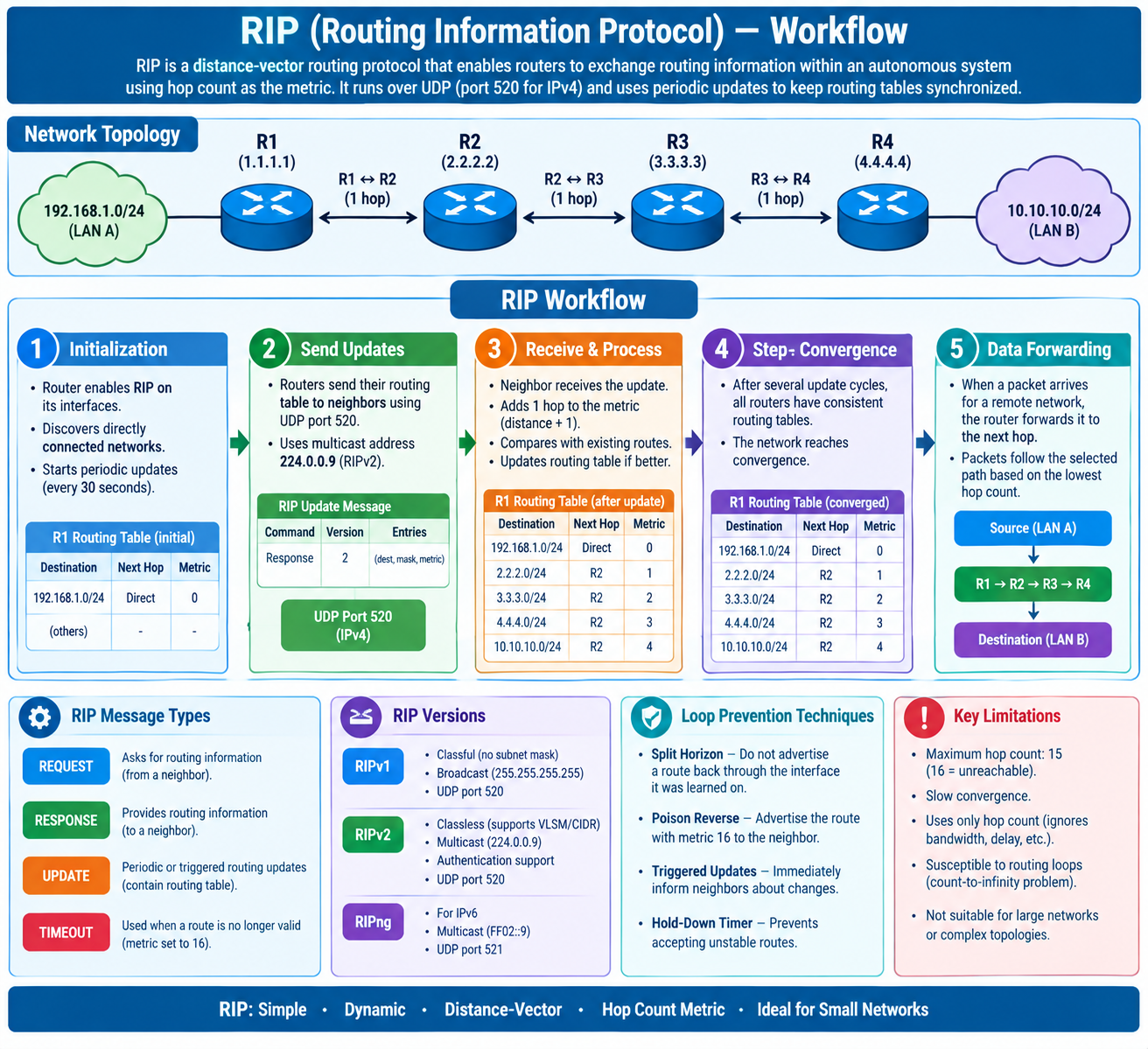
Introduction To RIP
Routing Information Protocol (RIP) Is A Traditional Dynamic Routing Protocol Used To Exchange Routing Information Between Routers Within An IP Network. It Belongs To The Family Of Interior Gateway Protocols (IGPs) And Is Designed Primarily For Routing Inside An Autonomous System. RIP Helps Routers Dynamically Discover Available Networks And Determine Paths Through A Distance-vector Routing Approach.
RIP And The Network Layer
The Network Layer Of The OSI Model Is Responsible For Logical Addressing, Packet Forwarding, Routing, And Determining Paths Between Different Networks. RIP Supports These Network Layer Functions By Allowing Routers To Exchange Information About Reachable IP Networks. Although RIP Uses UDP As Its Transport Mechanism, Its Primary Purpose Is To Build And Maintain IP Routing Information.
Full Form Of RIP
RIP Stands For Routing Information Protocol. It Is One Of The Earliest Widely Deployed Dynamic Routing Protocols For TCP/IP Networks. RIP Was Designed To Provide A Relatively Simple Mechanism Through Which Routers Could Automatically Learn Routes Instead Of Requiring Administrators To Manually Configure Every Destination Network.
Purpose Of RIP
The Main Purpose Of RIP Is To Enable Routers To Automatically Exchange Information About Network Destinations And Calculate Suitable Routes. Instead Of Maintaining Only Manually Configured Static Routes, A Router Running RIP Periodically Communicates With Neighboring Routers. Based On The Information Received, It Updates Its Routing Table And Selects Paths Toward Remote Networks.
RIP As An Interior Gateway Protocol
RIP Is Classified As An Interior Gateway Protocol (IGP) Because It Is Intended For Routing Within An Autonomous System. Other Important IGPs Include OSPF, IS-IS, And EIGRP. Unlike BGP, Which Is Primarily Used For Routing Between Autonomous Systems, RIP Is Designed For Relatively Small Internal Networks.
RIP As A Distance-Vector Protocol
RIP Is A distance-vector Routing Protocol. In A Distance-vector Approach, A Router Does Not Maintain A Complete Map Of The Network Topology. Instead, It Learns Destination Information From Neighboring Routers. Each Route Contains A Destination Network And A Metric Representing The Distance To That Network.
RIP And The Bellman-Ford Algorithm
The Underlying Routing Concept Used By RIP Is Based On The Bellman-Ford Algorithm. The Algorithm Allows Routers To Calculate The Shortest Path Based On Distances Reported By Neighboring Routers. Each Router Effectively Determines Whether Reaching A Destination Through A Particular Neighbor Provides A Better Route Than Its Currently Known Path.
RIP Metric: Hop Count
The Most Important Characteristic Of RIP Is Its Use Of hop Count As Its Routing Metric. A Hop Represents A Router That A Packet Must Traverse To Reach Its Destination. RIP Normally Considers A Route With Fewer Hops To Be Better Than A Route With More Hops. This Makes RIP Relatively Simple To Understand And Implement.
Maximum Hop Count
RIP Has A Fundamental Scalability Limitation Because Its Maximum Usable Hop Count Is 15. A Metric Of 16 Represents An Unreachable Network. Consequently, RIP Cannot Effectively Support Paths Requiring More Than 15 Router Hops. This Limitation Is One Of The Major Reasons RIP Is Generally Unsuitable For Large Modern Networks.
Example Of RIP Hop Count
Suppose Router A Is Directly Connected To Network X. Router B Reaches Network X Through Router A, Router C Reaches It Through Router B, And Router D Reaches It Through Router C. The Routers Can Calculate Increasing Hop Counts As The Destination Network Becomes Farther Away. RIP Selects The Available Path With The Lowest Applicable Hop Count.
RIP Routing Table
A Router Running RIP Maintains A Routing Table Containing Destination Networks, Next-hop Information, Interfaces, And Metrics. When Routing Updates Arrive From Neighboring Routers, The Router Evaluates The Received Information. If A Newly Learned Path Is Preferable, The Router Can Update Its Routing Information And Potentially Install The Route Into Its IP Forwarding Table.
RIP Routing Updates
Traditional RIP Operation Relies On Periodic Routing Updates. Routers Send Routing Information To Their Neighbors At Regular Intervals. These Updates Allow Neighboring Routers To Learn About Reachable Networks And Detect Changes In Routing Information. Periodic Updates Are An Important Characteristic Of Distance-vector Routing Protocols.
RIP And UDP
RIP Uses User Datagram Protocol (UDP) For Communication. For IPv4 RIP, The Standard Destination Port Is UDP Port 520. UDP Provides A Lightweight Transport Mechanism, While RIP Itself Handles The Exchange Of Routing Information. RIP Does Not Require A TCP Connection Between Routers Before Exchanging Routing Updates.
RIPv1
RIPv1 Is The Original Widely Standardized Version Of RIP For IPv4. It Is A classful Routing Protocol, Meaning That It Does Not Include Subnet-mask Information In Its Routing Updates. Because Of This Limitation, RIPv1 Does Not Properly Support Modern Classless Routing Architectures Involving Variable-length Subnet Masks.
RIPv2
RIPv2 Was Developed To Overcome Several Limitations Of RIPv1. It Is A classless Routing Protocol, Meaning That Routing Updates Contain Subnet-mask Information. This Enables RIPv2 To Support CIDR And Variable Length Subnet Masking (VLSM). RIPv2 Is Therefore Considerably More Flexible Than RIPv1 For IPv4 Networks.
RIPv2 Multicast Communication
RIPv2 Normally Uses The IPv4 Multicast Address 224.0.0.9 For Routing Updates. This Is An Improvement Over RIPv1's Broadcast-based Approach Because Multicast Can Limit The Distribution Of Routing Information To Devices Interested In Receiving RIP Updates. This Reduces Unnecessary Processing By Some Hosts On The Local Network.
Authentication In RIPv2
RIPv2 Supports Mechanisms For Authenticating Routing Updates. Authentication Helps Routers Distinguish Legitimate Routing Information From Unauthorized Updates. This Capability Is Important Because False Routing Advertisements Could Cause Incorrect Routing Decisions. However, The Security Mechanisms Available With Traditional RIP Are Limited Compared With Modern Cryptographically Protected Routing Approaches.
RIPng
For IPv6 Networks, The Corresponding Protocol Is RIPng, Meaning RIP Next Generation. RIPng Was Designed To Provide Distance-vector Routing For IPv6. It Uses UDP Port 521 And Operates With IPv6 Multicast. RIPng Retains The Basic Distance-vector Concept And Hop-count Metric While Adapting The Protocol For IPv6 Networks.
How RIP Starts Working
When A Router Is Configured To Run RIP, It Identifies The Interfaces And Networks Participating In RIP. It Then Begins Exchanging Routing Information With Neighboring RIP Routers. The Router Initially Knows Its Directly Connected Networks And Subsequently Learns About Remote Networks Through Routing Updates Received From Other Routers.
Neighboring Routers
RIP Routers Communicate With Neighboring Routers That Participate In The Same Routing Process. A Router Receives Routing Information From A Neighbor And Adds The Cost Of Reaching That Neighbor Before Calculating Its Own Distance To Each Destination. This Process Allows Routing Information To Gradually Propagate Throughout The Network.
Route Calculation In RIP
Suppose Router A Receives An Advertisement From Router B Stating That Network X Can Be Reached With A Metric Of Three. Router A Must Account For The Additional Hop Between Itself And Router B. Therefore, It May Calculate The Route To Network X With A Metric Of Four. If Four Is Better Than Its Existing Route, Router A Can Select The New Path.
Routing Information Exchange
The Fundamental Information Exchanged By RIP Consists Of Destination Network Information And Associated Metrics. Routers Use This Information To Construct A Distributed View Of Network Reachability. Because Each Router Learns Information From Its Neighbors, Changes Can Propagate Through Multiple Routers Until Routing Tables Converge.
RIP Convergence
Convergence Is The Process By Which Routers Reach Consistent Routing Information After A Network Change. RIP Convergence Can Be Relatively Slow Compared With Modern Routing Protocols. When A Link Fails, Routers May Require Multiple Update Cycles To Recognize The Change And Propagate The Information Throughout The Network.
Routing Loops
One Of The Major Challenges Of Distance-vector Routing Is The Possibility Of routing Loops. A Routing Loop Occurs When Routers Incorrectly Believe That Another Router Provides A Path Toward A Destination That Is Actually Unreachable. Packets May Then Circulate Between Routers Rather Than Reaching Their Destination.
Count-to-Infinity Problem
RIP Can Experience The Classic count-to-infinity Problem. After A Route Becomes Unavailable, Neighboring Routers May Incorrectly Advertise Increasing Metrics For That Destination To Each Other. The Metric Can Gradually Increase Until RIP Reaches Its Defined Unreachable Value Of 16. This Behavior Can Delay Convergence.
Split Horizon
Split Horizon Is A Technique Used To Reduce Routing Loops. Under Split Horizon, A Router Does Not Advertise A Route Back Through The Interface From Which It Originally Learned That Route. The Principle Prevents A Router From Unnecessarily Telling A Neighbor About A Destination Using That Same Neighbor As The Route Source.
Poison Reverse
Poison Reverse Is Another Loop-prevention Technique. When A Router Advertises A Route Back Toward The Neighbor From Which It Learned The Route, It Can Advertise The Destination With An Infinite Metric. In RIP, That Unreachable Metric Is 16. This Informs The Neighbor That The Route Should Not Be Used Through That Router.
Triggered Updates
RIP Can Use triggered Updates To Communicate Routing Changes Before The Next Regular Update Interval. For Example, If A Router Detects That A Network Has Become Unreachable, It Can Immediately Propagate The Change. Triggered Updates Can Improve Convergence Compared With Waiting For The Next Periodic Update.
RIP Timers
RIP Implementations Use Several Timers To Manage Route Information. Commonly Discussed Timers Include Update, Invalid, Hold-down, And Flush Timers. Traditional RIP Specifications Commonly Use Approximately 30 Seconds For Periodic Updates, Although Exact Timer Behavior Can Vary By Implementation And Configuration. These Timers Help Routers Determine Whether Route Information Remains Valid.
Route Timeout
If A Router Stops Receiving Valid Information About A Route For The Expected Period, It Can Mark The Route As Invalid. The Route May Then Be Advertised As Unreachable And Eventually Removed From The Routing Table. This Process Helps Routers Respond To Failures Even When Explicit Failure Information Is Unavailable.
RIP Administrative Distance
In Many Router Implementations, RIP Has An Associated administrative Distance Used To Compare Its Routes With Routes Learned From Other Routing Sources. The Exact Value Is Implementation-dependent. Administrative Distance Should Not Be Confused With RIP's Hop-count Metric: Administrative Distance Determines Trust Between Routing Sources, While Hop Count Determines The RIP Path Metric.
RIP And Static Routing
Static Routing Requires Administrators To Manually Configure Routes, Whereas RIP Dynamically Learns Routes. RIP Can Reduce Administrative Effort In Small Networks Because Routers Automatically Exchange Route Information. However, Static Routes May Be Preferable For Simple, Stable Topologies Where Administrators Require Precise Control Over Forwarding Behavior.
RIP Compared With OSPF
RIP And OSPF Are Both Interior Gateway Protocols, But Their Designs Are Very Different. RIP Uses Distance-vector Routing And Hop Count, Whereas OSPF Uses Link-state Routing And A Cost Metric. OSPF Builds A Topology Database And Uses The Shortest Path First Algorithm. OSPF Is Therefore Generally More Scalable And Feature-rich Than RIP.
RIP Compared With BGP
RIP And BGP Serve Very Different Purposes. RIP Is Primarily An Internal Routing Protocol For Smaller Autonomous Systems, While BGP Is The Principal Inter-domain Routing Protocol Used To Exchange Routes Between Autonomous Systems. RIP Uses Hop Count, Whereas BGP Uses Path Attributes And Policy-based Route Selection. BGP Is Designed For Internet-scale Routing.
Advantages Of RIP
One Of RIP's Major Advantages Is Simplicity. Its Configuration And Operational Concepts Are Comparatively Easy For Beginners To Understand. The Hop-count Metric Is Straightforward, And Small Networks Can Deploy RIP Without The Complexity Associated With More Advanced Protocols. RIP Is Therefore Useful For Educational Purposes And Certain Simple Network Environments.
Easy Configuration
RIP Can Generally Be Configured With Relatively Few Routing Commands On Supported Routers. Once Enabled, Participating Routers Can Automatically Exchange Network Information. This Reduces The Need To Manually Configure Individual Routes Throughout A Small Topology. Its Simplicity Makes RIP Useful When Advanced Traffic-engineering Capabilities Are Unnecessary.
Automatic Route Discovery
A Major Benefit Of Dynamic Routing Is Automatic Route Discovery. With RIP, Routers Can Learn Remote Networks Without Requiring Administrators To Manually Specify Every Possible Destination. When Network Topology Changes, RIP Can Update Routing Information Automatically, Subject To Its Convergence Characteristics.
Limitations Of RIP
RIP Has Several Significant Limitations. The 15-hop Maximum Restricts Its Usable Network Size. Hop Count Also Ignores Bandwidth, Latency, Congestion, And Link Quality. A Slow Link With One Hop May Be Preferred Over A Faster Path With Two Hops. RIP's Periodic Updates And Convergence Behavior Can Also Make It Inefficient For Large Networks.
RIP Scalability
RIP Is Not Designed For Large-scale Enterprise, Service-provider, Or Internet Routing. As Network Size Increases, The Amount Of Routing Information And Update Traffic Can Become Inefficient. The 15-hop Limit Further Restricts Its Applicability. Modern Networks Commonly Use Protocols Such As OSPF, IS-IS, Or Other Appropriate Routing Technologies Instead.
RIP Security Considerations
Routing Protocols Are Important Security Components Because Incorrect Routing Information Can Redirect Network Traffic. RIP Can Be Exposed To Unauthorized Or Incorrect Route Advertisements If Network Controls Are Poorly Configured. Network Administrators Should Use Appropriate Authentication Where Supported, Restrict Which Interfaces Participate In RIP, And Apply Filtering And Access-control Policies.
RIP In Small Networks
RIP Can Still Be Useful In Small Networks With Simple Topologies And Limited Routing Requirements. A Small Laboratory, Classroom, Training Environment, Or Legacy Network May Use RIP To Demonstrate Dynamic Routing. Its Straightforward Metric And Operation Make It Particularly Valuable For Teaching Routing Fundamentals.
RIP In Networking Education
RIP Is An Important Educational Protocol Because It Demonstrates Several Fundamental Networking Concepts. Students Can Use RIP To Understand Distance-vector Routing, Routing Tables, Hop Counts, Convergence, Routing Loops, Split Horizon, Poison Reverse, And Dynamic Route Updates. These Concepts Provide A Foundation For Understanding More Sophisticated Routing Protocols.
RIP Packet Structure
A RIP Message Contains Protocol Fields Followed By Routing Entries. Important Information Includes The Command Indicating Whether The Message Is A Request Or Response And The Routing Information Associated With Destination Networks. RIPv2 Also Carries Additional Information Such As Subnet Masks, Next-hop Information, And Route-related Attributes.
RIP Request And Response
RIP Defines Request And Response Operations For Exchanging Routing Information. A Router Can Request Routing Information, While Another Router Can Respond With The Relevant Routing Entries. Periodic Routing Advertisements Also Allow Routers To Maintain Current Information About Reachable Destinations.
RIP And Route Aggregation
RIPv2's Support For Classless Routing Makes It Possible To Work With Subnetted Networks And CIDR Prefixes. Route Summarization Can Reduce Routing Information Where Appropriate. However, RIP Remains Constrained By Its Basic Distance-vector Architecture And Hop-count Metric, So Classless Support Does Not Eliminate Its Fundamental Scalability Limitations.
RIP And Modern Networks
In Modern Enterprise Environments, RIP Has Largely Been Replaced By More Capable Protocols. OSPF And IS-IS Provide Better Scalability And Richer Topology Information, While Other Environments May Use Different Routing Technologies According To Their Requirements. Nevertheless, RIP Remains Relevant For Understanding The Historical Development And Fundamental Concepts Of IP Routing.
Practical Example Of RIP
Consider A Network Containing Four Routers Connected Sequentially: R1, R2, R3, And R4. If A Destination Network Is Directly Connected To R4, R3 Can Learn It With A Low Hop Count, Followed By R2 And R1. If R1 Has Multiple Possible Paths, RIP Generally Selects The Reachable Route With The Lowest Hop-count Metric.
Importance Of RIP In Computer Networks
RIP Played An Important Role In The Development Of Dynamic IP Routing. It Demonstrated How Routers Could Exchange Routing Information Automatically Without Maintaining A Centralized Routing Database. Concepts Introduced And Reinforced Through RIP, Including Distance Vectors And Loop-prevention Mechanisms, Remain Important When Studying Routing Protocols And Distributed Network Algorithms.
RIP In The Network Layer: Overall Significance
From A Network Layer Perspective, RIP Demonstrates How Routers Can Dynamically Determine Paths Between IP Networks. It Takes Information Received From Neighboring Routers, Calculates Route Metrics, Maintains Routing Entries, And Updates Forwarding Decisions. Although RIP Itself Communicates Using UDP, Its Operational Purpose Is Directly Related To IP Routing And Network Layer Connectivity.
Conclusion
Routing Information Protocol Is A Classic Distance-vector Interior Gateway Protocol That Enables Routers Within An Autonomous System To Dynamically Exchange IP Routing Information. Its Use Of Hop Count, UDP Communication, Periodic Updates, Route Timers, And Loop-prevention Techniques Makes It Relatively Simple To Understand And Implement. RIPv1 Introduced Basic IPv4 Dynamic Routing, RIPv2 Added Classless Routing And Other Improvements, And RIPng Extended The Concept To IPv6.
However, The 15-hop Limit, Slow Convergence, Limited Routing Metric, And Scalability Constraints Make RIP Unsuitable For Many Modern Large Networks. Despite These Limitations, RIP Remains Highly Valuable For Learning The Fundamental Principles Of Dynamic Routing, Distance-vector Algorithms, Routing Tables, Convergence, And Network Layer Path Selection.
Tags:
Routing Information Protocol, RIP, Network Layer, Full Form Of RIP, Purpose Of RIP, RIP As An Interior Gateway Protocol