BGP In The Network Layer: Definition, Architecture, Working, Features, Security, And Applications
Category: NETWORKING | 15th September 2026, Tuesday
Introduction To BGP
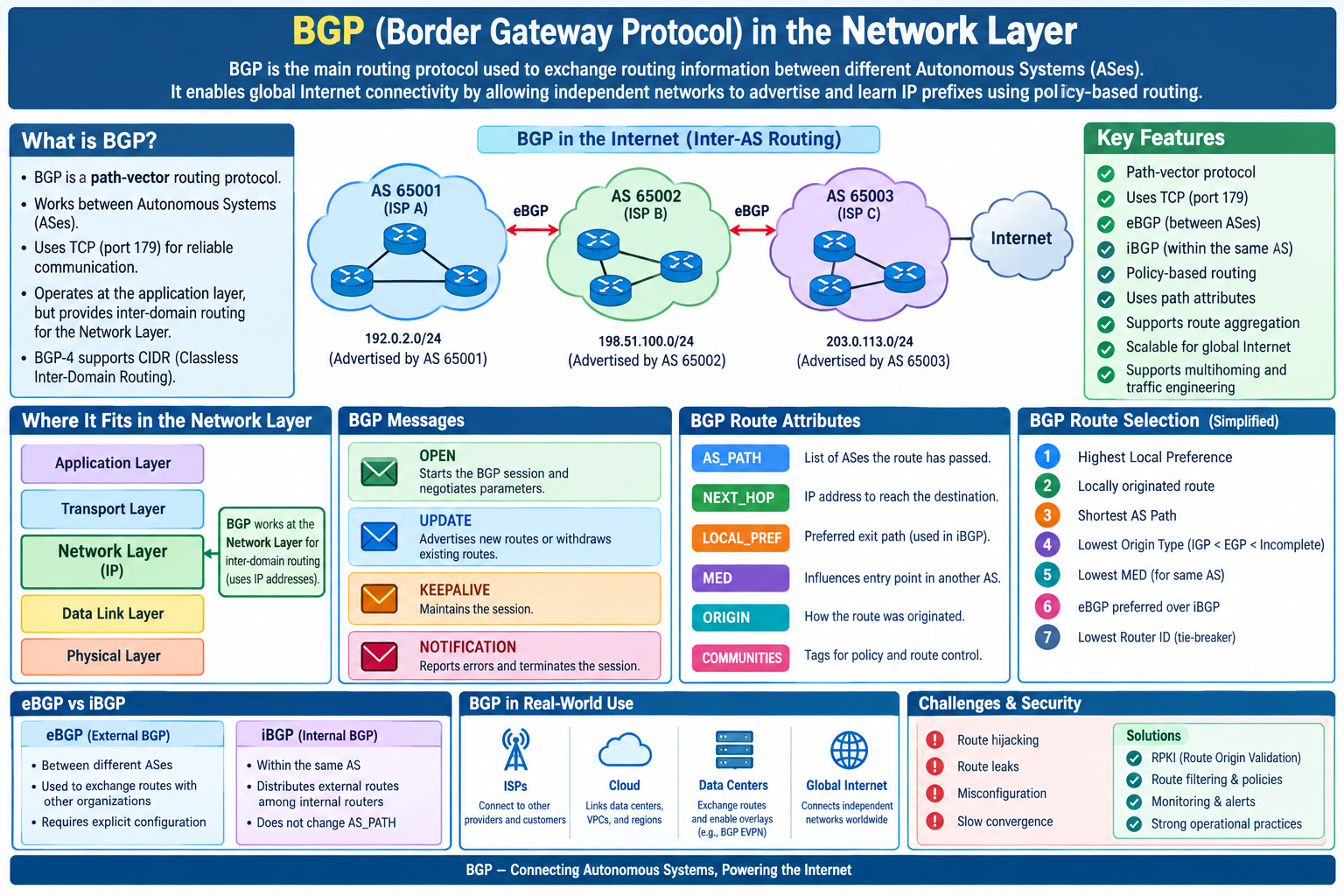
Border Gateway Protocol (BGP) Is The Principal Routing Protocol Used To Exchange Routing Information Between Different Autonomous Systems (ASes) On The Internet. Although BGP Operates Primarily At The Application Layer Over TCP From A Protocol-stack Perspective, It Performs A Critical inter-domain Routing Function Associated With The Internet/Network Layer. BGP Enables Internet Service Providers, Cloud Providers, Enterprises, Universities, Data Centers, And Other Organizations To Advertise And Learn IP Network Prefixes. It Determines How Traffic Should Travel From One Autonomous System To Another And Is Therefore Fundamental To Global Internet Connectivity.
What Is An Autonomous System?
An Autonomous System Is A Collection Of IP Networks And Routers Operated By One Organization Or Under A Common Routing Policy. Every AS Is Identified By An Autonomous System Number (ASN). ASNs Are Allocated Through Internet Number Registries And Are Used By BGP To Identify Routing Domains. For Example, An Internet Service Provider May Operate One Or More ASes Containing Thousands Of Routers And Customer Networks. BGP Uses ASN Information To Construct Routing Paths And Prevent Routing Loops.
BGP And The Network Layer
The Network Layer Is Responsible For Delivering Packets Between Networks Using Logical Addressing And Routing. BGP Contributes To This Objective By Determining Reachable IP Prefixes And Exchanging Routing Information Between Independent Routing Domains. Unlike Protocols Such As OSPF, Which Generally Calculate Routes Inside An Organization, BGP Focuses Primarily On inter-domain Routing. Consequently, BGP Is Often Described As The Routing Protocol That Connects The Autonomous Systems Forming The Internet.
Why BGP Is Required
The Internet Consists Of An Enormous Number Of Independently Administered Networks. A Single Routing Protocol Using One Centralized Algorithm Would Not Be Practical Because Organizations Have Different Business Relationships, Security Requirements, Performance Objectives, And Routing Policies. BGP Solves This Problem Through policy-based Routing. Instead Of Selecting Routes Only According To The Shortest Physical Distance, BGP Allows Network Administrators To Define Which Routes Should Be Accepted, Rejected, Preferred, Or Advertised.
BGP As A Path-Vector Protocol
BGP Is Classified As A path-vector Routing Protocol. In A Path-vector System, Routing Information Contains Information About The Sequence Of Autonomous Systems Through Which A Route Can Be Reached. One Of The Most Important BGP Attributes Is The AS_PATH, Which Records The ASes Associated With A Route Advertisement. This Path Information Allows Routers To Evaluate Routes And Provides An Important Mechanism For Detecting Routing Loops.
BGP Versions
The Version Of BGP Used On The Modern Internet Is BGP-4. BGP-4 Introduced Important Capabilities Such As Classless Inter-Domain Routing (CIDR), Allowing Networks To Be Represented Using Variable-length Prefixes Rather Than Traditional Classful Addressing. CIDR Significantly Improved Internet Address Utilization And Reduced Routing-table Growth Compared With Older Class-based Approaches.
BGP Uses TCP
BGP Uses Transmission Control Protocol (TCP) As Its Transport Protocol. BGP Normally Establishes A TCP Session Using TCP Port 179 Between Two BGP-speaking Routers. Using TCP Provides Reliable, Ordered Delivery Of BGP Messages. Consequently, BGP Does Not Need To Implement Its Own Retransmission Mechanism For Every Routing Update. Once The TCP Session Is Established, The BGP Peers Can Exchange Routing Information.
BGP Neighbors Or Peers
Two Routers Participating In A BGP Relationship Are Called BGP Peers Or BGP Neighbors. They Establish A BGP Session And Exchange Routing Information. A BGP Router Does Not Automatically Become A Peer With Every Router It Can Reach. Network Administrators Explicitly Configure BGP Neighbor Relationships. This Design Provides Considerable Control Over Which Routers Are Allowed To Exchange Routing Information.
External BGP (eBGP)
External BGP, Commonly Called eBGP, Is Used To Exchange Routing Information Between Different Autonomous Systems. For Example, An Internet Service Provider May Establish An EBGP Relationship With Another Provider, A Cloud Network, Or A Customer Organization. EBGP Is The Mechanism Through Which Independent Autonomous Systems Advertise Their Reachable IP Prefixes To Each Other.
Internal BGP (iBGP)
Internal BGP, Or iBGP, Is Used Between BGP Routers Within The Same Autonomous System. An Organization May Use IBGP To Distribute Externally Learned Routes Among Multiple Routers. IBGP Plays An Important Role In Large Networks Where Many Routers Need Access To External Routing Information While Internal Routing Protocols Such As OSPF Or IS-IS Handle Reachability Inside The AS.
BGP Route Advertisement
BGP Routers Advertise IP Prefixes That They Can Reach. A Prefix Represents A Range Of IP Addresses, Such As 203.0.113.0/24. When An Organization Announces A Prefix Through BGP, Neighboring Networks Can Learn That The Organization Provides A Path Toward That Destination. The Receiving Router Evaluates The Advertisement According To Its Routing Policy And BGP Path-selection Rules.
BGP Routing Information
A BGP Route Is More Than Simply A Destination And Next-hop Address. BGP Associates Several path Attributes With A Route. These Attributes Describe Characteristics Of The Path And Provide Information Used During Route Selection. Important Attributes Include AS_PATH, NEXT_HOP, LOCAL_PREF, MED, ORIGIN, And Communities. The Combination Of These Attributes Allows BGP To Make Sophisticated Routing Decisions.
BGP UPDATE Messages
The Primary BGP Message Used To Exchange Routing Information Is The UPDATE Message. An UPDATE Can Advertise New Reachable Prefixes And Withdraw Previously Advertised Prefixes. For Example, If A Network Becomes Unreachable, A BGP Router Can Send An Update Indicating That The Corresponding Route Should Be Withdrawn. This Enables Routing Information To Change Dynamically As Internet Connectivity Changes.
BGP OPEN Message
After Establishing A TCP Connection, BGP Peers Exchange OPEN Messages. The OPEN Message Allows Each Router To Identify Itself And Negotiate Important Session Parameters. It Contains Information Such As The BGP Version, Autonomous System Number, BGP Identifier, And Hold Time. If The Parameters Are Acceptable, The Peers Proceed With The BGP Session Establishment Process.
BGP KEEPALIVE Message
BGP Uses KEEPALIVE Messages To Maintain An Established Session. These Messages Are Exchanged Periodically Between Peers. If A Router Does Not Receive Expected BGP Messages Within The Configured Hold-time Interval, It May Consider The Neighboring Peer Unavailable And Terminate The BGP Session. KEEPALIVE Messages Therefore Help Detect Communication Failures.
BGP NOTIFICATION Message
A NOTIFICATION Message Is Used When A Serious Error Occurs In A BGP Session. The Message Contains Information Identifying The Type Of Error. After Sending A NOTIFICATION, The BGP Session Is Normally Terminated. Errors Can Involve Malformed Messages, Incorrect Configuration, Unsupported Parameters, Or Other Protocol Problems.
BGP Finite State Machine
BGP Sessions Progress Through Several States Defined By A Finite State Machine. Important States Include Idle, Connect, Active, OpenSent, OpenConfirm, And Established. The Established State Indicates That The BGP Session Is Operational And Peers Can Exchange Routing Information. Understanding These States Is Particularly Important For Network Administrators Troubleshooting BGP Connectivity Problems.
BGP Route Selection
A BGP Router May Receive Multiple Routes To The Same Destination. BGP Therefore Needs A Route-selection Process To Determine Which Route Should Become The Preferred Path. The Selection Process Considers Attributes And Locally Configured Policies. Depending On The Implementation And Configuration, Factors Such As Local Preference, Locally Originated Routes, AS Path Length, Origin Type, MED, EBGP/iBGP Preference, And Router-specific Tie-breakers Can Influence The Final Selection.
AS_PATH Attribute
The AS_PATH Attribute Records Autonomous-system Path Information Associated With A Route. When An EBGP Router Advertises A Route To Another AS, Its ASN Is Normally Added To The Path. If A Router Receives An Advertisement Containing Its Own ASN In The AS_PATH, It Can Recognize That Accepting The Route Would Create An AS-level Routing Loop. It Can Therefore Reject The Route.
LOCAL_PREF Attribute
LOCAL_PREF, Or Local Preference, Is Primarily Used Inside An Autonomous System To Indicate Which External Exit Path Should Be Preferred. A Higher Local-preference Value Is Generally Preferred. Network Administrators Can Use LOCAL_PREF To Control Which Upstream Provider Or External Connection Carries Outbound Traffic. This Makes LOCAL_PREF An Important Policy-control Mechanism In Multi-homed Networks.
MED Attribute
The Multi-Exit Discriminator (MED) Can Be Used To Influence Which Entry Point Another AS Should Prefer When Multiple Links Exist Between Two Autonomous Systems. A Lower MED Is Generally Preferred When Comparing Otherwise Eligible Routes Under The Relevant Selection Rules. MED Is Commonly Used When An Organization Has Multiple Connections To The Same Neighboring AS.
NEXT_HOP Attribute
The NEXT_HOP Attribute Identifies The IP Address Toward Which Traffic Should Be Forwarded For A BGP Route. The BGP Control Plane Determines Reachability, While The Router's Forwarding System Ultimately Uses The Selected Route To Forward Packets. The Next-hop Address Must Itself Be Reachable Through An Appropriate Underlying Routing Mechanism.
BGP Communities
BGP Communities Are Tags Attached To Routes To Simplify Routing Policy. Network Operators Can Use Communities To Classify Routes And Communicate Policy Information Between Routers Or Organizations. For Example, A Provider Might Define Communities Representing Customer Routes, Backup Routes, Geographic Regions, Or Special Routing Preferences. Communities Make Large-scale BGP Policy Management Considerably Easier.
BGP Routing Table
A BGP Router Maintains Information About Routes Learned From Its Peers. In Conceptual Terms, A BGP Implementation Distinguishes Between Routes Received From Peers, Routes Selected As Best, And Routes Installed Into The Forwarding System. The Exact Internal Structures Vary By Vendor. The Important Principle Is That BGP Can Maintain Multiple Candidate Routes While Selecting The Preferred Route For Forwarding.
BGP And OSPF
BGP And OSPF Have Different Primary Purposes. OSPF Is An Interior Gateway Protocol Designed To Calculate Routes Within An Autonomous System, Whereas BGP Is Designed Mainly For Exchanging Routing Information Between Autonomous Systems. OSPF Uses A Link-state Approach And Dijkstra's Shortest-path Algorithm, While BGP Uses Path-vector Routing And Policy-based Route Selection. Large Networks Can Use Both Protocols Simultaneously.
BGP And IS-IS
IS-IS Is Another Interior Gateway Protocol Commonly Used By Service Providers. Like OSPF, It Is Designed Primarily For Routing Within An Autonomous System. BGP, In Contrast, Provides Inter-domain Routing. A Service Provider Might Use IS-IS To Establish Internal Reachability Between Routers And BGP To Exchange Customer And Internet Routes With Other Autonomous Systems.
BGP Route Convergence
Convergence Refers To The Process Through Which Routers Update Their Routing Information Following A Topology Or Reachability Change. BGP Convergence Can Be Slower Than That Of Some Interior Routing Protocols Because BGP Emphasizes Policy, Stability, Scalability, And Inter-domain Coordination. Slow Convergence Can Be Undesirable For Applications Requiring Highly Predictable Connectivity, Although Modern Implementations Provide Various Mechanisms To Improve Convergence.
BGP Scalability
One Of BGP's Most Important Characteristics Is Its Ability To Operate At Internet Scale. Global BGP Routing Tables Contain A Very Large Number Of IP Prefixes. BGP's Hierarchical Organization Around Autonomous Systems And Its Policy-based Operation Allow Independent Organizations To Exchange Routes Without Requiring A Single Centralized Routing Authority. Route Aggregation And Other Mechanisms Can Further Reduce Routing-table Complexity.
Route Aggregation
BGP Supports route Aggregation, Which Allows Multiple Smaller Prefixes To Be Represented By A Larger Summarized Prefix When Appropriate. For Example, Several Contiguous Networks May Potentially Be Represented By A Common Prefix. Aggregation Can Reduce The Number Of Routes Exchanged Between Networks, Decreasing Routing-table Size And Update Traffic. However, Aggregation Must Be Designed Carefully To Avoid Accidentally Advertising Unreachable Address Space.
BGP Multihoming
Organizations Frequently Connect To More Than One Internet Service Provider For Redundancy, Resilience, Or Traffic Engineering. This Arrangement Is Called multihoming. BGP Allows The Organization To Advertise Its Prefixes Through Multiple Providers And Influence Inbound And Outbound Traffic Paths. If One Provider Connection Fails, Alternative Paths Can Remain Available, Improving Internet Connectivity.
BGP Traffic Engineering
Traffic Engineering Refers To Controlling How Network Traffic Enters And Leaves An Organization. BGP Provides Several Mechanisms For Influencing Route Selection. Operators Can Manipulate Attributes Such As LOCAL_PREF, AS_PATH, MED, Communities, And Route Advertisements. For Example, An Organization May Prefer One Provider For Normal Outbound Traffic While Maintaining Another Provider As A Backup.
BGP Security Risks
BGP Was Designed Primarily For Trusted Exchanges Between Network Operators And Does Not Inherently Provide Comprehensive Cryptographic Validation Of Every Route Advertisement. Consequently, Incorrect Or Malicious Routing Information Can Create Significant Risks. A Wrongly Advertised Prefix Can Cause Traffic To Be Redirected, Disrupted, Or Dropped. Such Incidents Demonstrate Why BGP Security Is An Important Component Of Modern Internet Infrastructure.
BGP Route Hijacking
A BGP Route Hijack Occurs When An Autonomous System Advertises A Route That It Should Not Originate Or Otherwise Attracts Traffic Belonging To Another Network. Route Hijacking Can Be Accidental Or Malicious. The Consequences May Include Service Outages, Traffic Interception Opportunities, Or Redirection To An Unintended Network. Strong Filtering, Monitoring, And Route-validation Mechanisms Help Reduce This Risk.
BGP Route Leaks
A route Leak Occurs When Routing Information Is Propagated Beyond The Scope Intended By The Network Operator. For Example, A Network Might Unintentionally Advertise Routes Learned From One Provider To Another Provider, Causing Unexpected Traffic Flows. Route Leaks Can Produce Large-scale Internet Disruptions. Careful Routing Policies, Prefix Filtering, And Operational Controls Are Important Defenses.
RPKI And BGP Security
Resource Public Key Infrastructure (RPKI) Provides A Mechanism For Validating Whether An Autonomous System Is Authorized To Originate A Particular IP Prefix. Network Operators Can Create Route Origin Authorizations (ROAs), Which Specify Permitted Origin ASNs For Prefixes. Routers Performing Route Origin Validation (ROV) Can Classify Received Routes According To Whether The Origin Is Valid, Invalid, Or Unknown. RPKI Therefore Improves Protection Against Many Forms Of Accidental Or Malicious Route-origin Errors.
BGP Monitoring
Because BGP Is Critical To Internet Connectivity, Continuous Monitoring Is Essential. Network Administrators Monitor BGP Session Status, Route Changes, Prefix Counts, AS Paths, Announcements, Withdrawals, And Routing-policy Behavior. Sudden Changes In Advertised Prefixes Can Indicate Configuration Mistakes Or Security Incidents. Monitoring Systems Can Provide Alerts When Abnormal Routing Behavior Is Detected.
BGP In Internet Service Providers
Internet Service Providers Rely Heavily On BGP To Exchange Routes With Other Providers, Customers, Content Networks, Cloud Platforms, And Internet Exchange Participants. A Large ISP May Operate Hundreds Or Thousands Of BGP Sessions. BGP Enables The ISP To Implement Commercial And Engineering Policies While Maintaining Connectivity With The Global Internet.
BGP In Cloud Computing And Data Centers
Modern Cloud Platforms Use BGP Extensively For Connecting Data Centers, Virtual Networks, Edge Locations, And External Networks. BGP Can Exchange Routes Between Physical And Virtual Routing Domains And Can Support Scalable Network Architectures. In Data Centers, Technologies Such As BGP EVPN Extend BGP's Role Beyond Traditional Internet Routing Into Modern Overlay And Ethernet Virtualization Environments.
Advantages And Limitations Of BGP
BGP Provides Exceptional Scalability, Policy Control, Autonomous-system-based Routing, Multihoming Support, Route Aggregation, And Inter-provider Connectivity. However, It Is Also Complex To Configure And Troubleshoot. Incorrect Policies Can Cause Outages, Route Leaks, Or Inefficient Traffic Paths. BGP Convergence Can Also Be Relatively Slow, And The Protocol Requires Careful Security Controls. Therefore, BGP Should Be Operated With Disciplined Configuration, Monitoring, Filtering, And Validation.
Conclusion
Border Gateway Protocol Is One Of The Most Important Routing Protocols In Modern Computer Networking. It Enables Autonomous Systems To Exchange IP Reachability Information And Forms The Foundation Of Global Internet Routing. BGP Differs Fundamentally From Interior Routing Protocols Because It Combines Path Information With Administrative And Business Policies. Its Use Of TCP, Path Attributes, AS_PATH, Route Selection, Communities, Multihoming, Traffic Engineering, And Security Mechanisms Allows Independent Networks To Cooperate While Maintaining Administrative Control. Although BGP Has Significant Complexity And Security Challenges, Technologies Such As RPKI, Route Filtering, Monitoring, And Careful Policy Design Continue To Strengthen Its Operation. Understanding BGP Is Therefore Essential For Advanced Study Of The Network Layer, Internet Routing, ISP Networks, Cloud Infrastructure, Data Centers, And Cybersecurity.
Tags:
Network Layer, Internet Routing, ISP Networks, Cloud Infrastructure, Data Centers, And Cybersecurity