Modes Of Operation: Electronic Codebook (ECB), Cipher Block Chaining (CBC), Output Feedback (OFB), And Counter (CTR) Modes
Category: CRYPTOGRAPHY | 6th October 2026, Tuesday
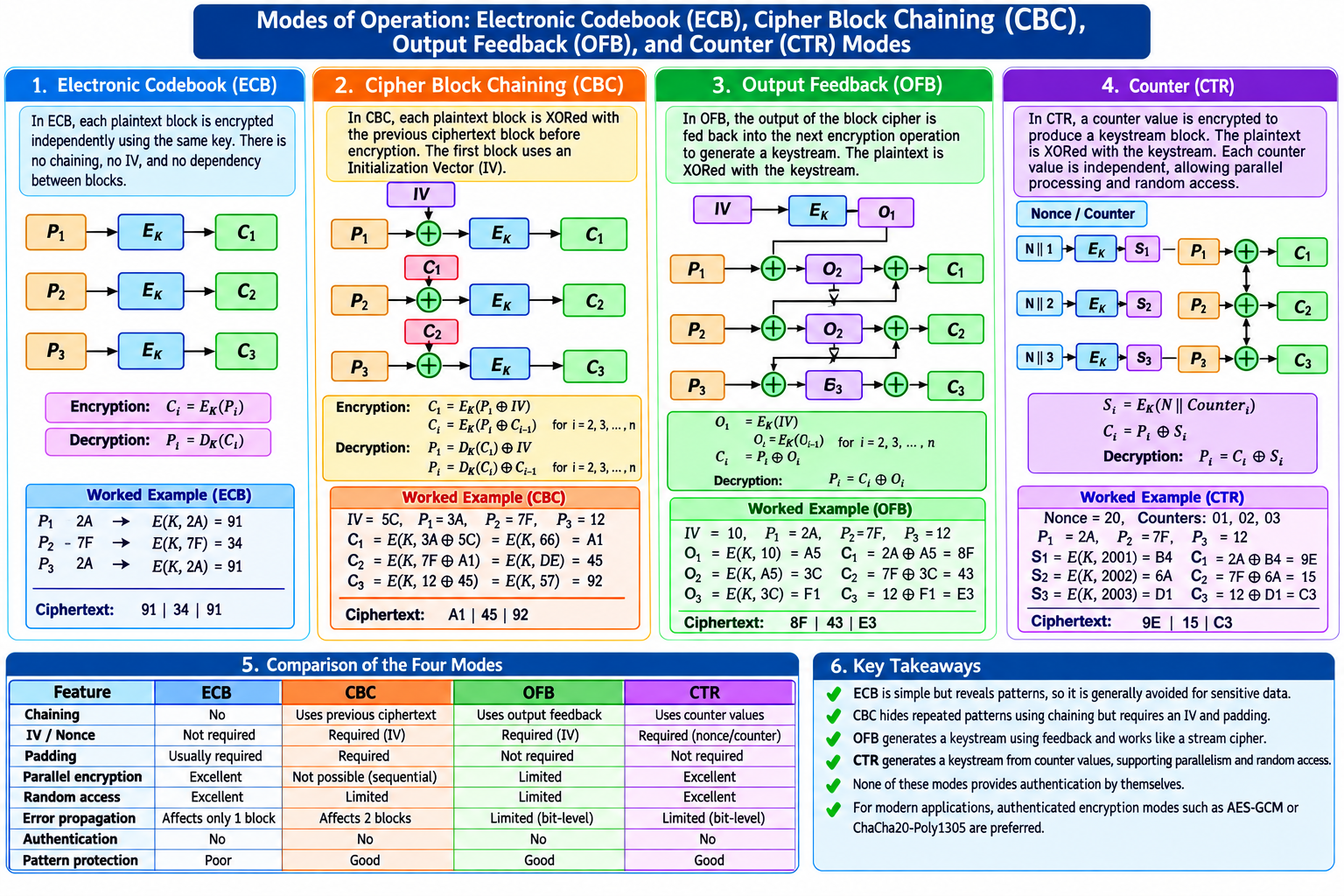
Modes Of Operation: ECB, CBC, OFB, And CTR
Introduction
A Block Cipher Is A Symmetric-key Cryptographic Algorithm That Encrypts Information In Fixed-size Blocks. Examples Include The Advanced Encryption Standard (AES) And The Older Data Encryption Standard (DES). AES Operates On 128-bit Blocks, While DES Operates On 64-bit Blocks.
Real-world Messages Are Usually Much Longer Than One Block. A Mechanism Is Therefore Required To Apply A Block Cipher Repeatedly To An Entire Message. These Mechanisms Are Called modes Of Operation.
A Mode Of Operation Specifies How Plaintext Blocks, Ciphertext Blocks, Initialization Vectors, Nonces, Counters, And Cryptographic Keys Interact. Different Modes Have Different Properties Regarding Confidentiality, Error Propagation, Parallel Processing, Padding, And Security.
Four Important Classical Modes Are:
-
Electronic Codebook (ECB)
-
Cipher Block Chaining (CBC)
-
Output Feedback (OFB)
-
Counter (CTR)
ECB Encrypts Each Block Independently. CBC Links Plaintext Blocks Through Previous Ciphertext. OFB Generates A Feedback-based Keystream, While CTR Generates A Keystream From Counter Values.
The Following Sections Explain Each Mode And Provide Worked Examples.
Basic Notation
The Following Notation Is Used Throughout:
-
P? = Plaintext Block
-
C? = Ciphertext Block
-
K = Secret Key
-
E?(X) = Encryption Of X Using Key K
-
D?(X) = Decryption Of X Using Key K
-
IV = Initialization Vector
-
N = Nonce
-
⊕ = XOR Operation
For Simplicity, The Worked Examples Use Small Hexadecimal Values Such As 3A And 7F. These Are toy Examples Intended To Demonstrate The Mode's Operation. In A Real System, The Block Cipher Would Perform A Much More Complex Transformation Such As AES.
XOR Operation
XOR Is Particularly Important In CBC, OFB, And CTR.
The Basic Rules Are:
| A | B | A ⊕ B |
|---|---|---|
| 0 | 0 | 0 |
| 0 | 1 | 1 |
| 1 | 0 | 1 |
| 1 | 1 | 0 |
For Hexadecimal Values, XOR Is Performed Bit By Bit.
For Example:
3A XOR 5CConvert Them To Binary:
3A = 0011 1010
5C = 0101 1100
XOR:
0011 1010
0101 1100
---------
0110 0110
Therefore:
3A ⊕ 5C = 66Another Example:
66 ⊕ 66 = 00This Property Is Important Because:
A ⊕ B ⊕ B = AElectronic Codebook (ECB) Mode
Definition
Electronic Codebook (ECB) Is The Simplest Block-cipher Mode. Each Plaintext Block Is Encrypted Independently Using The Same Key.
The Encryption Equation Is:
C? = E?(P?)
The Decryption Equation Is:
P? = D?(C?)
There Is No Chaining Between Blocks And No IV.
The Structure Is:
P1 ??> E(K) ??> C1

P2 ??> E(K) ??> C2

P3 ??> E(K) ??> C3
Worked ECB Encryption Example
To Demonstrate ECB, Suppose A Simplified Block Cipher Produces The Following Results:
E(K, 2A) = 91
E(K, 7F) = 34
E(K, 2A) = 91
Suppose The Plaintext Consists Of Three Blocks:
P1 = 2A
P2 = 7F
P3 = 2A
Step 1: Encrypt P?
C1 = E(K, P1)

C1 = E(K, 2A)

C1 = 91
Step 2: Encrypt P?
C2 = E(K, P2)

C2 = E(K, 7F)

C2 = 34
Step 3: Encrypt P?
C3 = E(K, P3)

C3 = E(K, 2A)

C3 = 91
Therefore:
Plaintext:  2A | 7F | 2A
Ciphertext: 91 | 34 | 91
Notice That:
P1 = P3and Consequently:
C1 = C3This Demonstrates The Major Weakness Of ECB.
Important Observation
ECB Reveals Repeated Plaintext Patterns:
P1 = P3
        ↓
C1 = C3
An Attacker May Therefore Learn Structural Information About The Plaintext Even Without Knowing The Encryption Key.
This Is Why ECB Should Generally not Be Used For Encrypting Structured Sensitive Data.
Cipher Block Chaining (CBC)
Definition
Cipher Block Chaining Connects Each Plaintext Block To The Previous Ciphertext Block.
The First Block Uses An Initialization Vector:
C? = E?(P? ⊕ IV)
For Subsequent Blocks:
C? = E?(P? ⊕ C???)
The Structure Is:
          IV
           |
           V
P1 -----> XOR -----> E(K) -----> C1
                                  |
                                  V
P2 ----------------> XOR ------> E(K) -----> C2
                                               |
                                               V
P3 --------------------------------> XOR ----> E(K) -----> C3
Worked CBC Encryption Example
Consider The Following Simplified Example:
IV = 5C

P1 = 3A
P2 = 7F
P3 = 12
Assume Our Toy Block Cipher Produces:
E(K, 66) = A1
E(K, DE) = 45
E(K, 57) = 92
We Now Perform CBC Encryption Step By Step.
Step 1: Encrypt The First Block
The First Plaintext Block Is XORed With The IV:
P1 ⊕ IV
= 3A ⊕ 5C
= 66
Now Encrypt The Result:
C1 = E(K, 66)

C1 = A1
Therefore:
C1 = A1Step 2: Encrypt The Second Block
The Second Plaintext Block Is XORed With The Previous Ciphertext:
P2 ⊕ C1
= 7F ⊕ A1
Convert To Binary:
7F = 0111 1111
A1 = 1010 0001
XOR:
0111 1111
1010 0001
---------
1101 1110
Therefore:
7F ⊕ A1 = DENow Encrypt:
C2 = E(K, DE)

C2 = 45
Therefore:
C2 = 45Step 3: Encrypt The Third Block
Now XOR P? With C?:
P3 ⊕ C2
= 12 ⊕ 45
= 57
Then Encrypt:
C3 = E(K, 57)

C3 = 92
Therefore:
C3 = 92Final CBC Ciphertext
IV = 5C

Plaintext:
3A | 7F | 12

Ciphertext:
A1 | 45 | 92
The Complete Calculation Is:
C1 = E(K, 3A ⊕ 5C)
   = E(K, 66)
   = A1

C2 = E(K, 7F ⊕ A1)
   = E(K, DE)
   = 45

C3 = E(K, 12 ⊕ 45)
   = E(K, 57)
   = 92
This Demonstrates The chaining Principle.
CBC Decryption Example
The Same Example Can Be Reversed.
We Have:
IV = 5C

C1 = A1
C2 = 45
C3 = 92
Assume:
D(K, A1) = 66
D(K, 45) = DE
D(K, 92) = 57
Recover P?
P1 = D(K, C1) ⊕ IV

P1 = 66 ⊕ 5C

P1 = 3A
Recover P?
P2 = D(K, C2) ⊕ C1

P2 = DE ⊕ A1

P2 = 7F
Recover P?
P3 = D(K, C3) ⊕ C2

P3 = 57 ⊕ 45

P3 = 12
Therefore:
Recovered Plaintext:

3A | 7F | 12
This Verifies The CBC Encryption Process.
Advantages And Disadvantages Of CBC
Advantages
-
Hides Repeated Plaintext Patterns Better Than ECB.
-
Widely Supported In Legacy Cryptographic Systems.
-
Provides Strong Confidentiality When Correctly Implemented.
-
Can Be Combined With A Separate Authentication Mechanism.
Disadvantages
-
Encryption Is Sequential.
-
Requires Padding For Non-block-aligned Plaintext.
-
Requires Careful IV Generation.
-
Does Not Provide Authentication By Itself.
-
Poor Implementations May Be Vulnerable To Padding Oracle Attacks.
-
Ciphertext Modification Can Affect Multiple Plaintext Blocks.
Output Feedback (OFB) Mode
Output Feedback Mode Converts A Block Cipher Into A Stream-like Cipher.
Instead Of Feeding Ciphertext Back Into The Cipher, OFB Feeds The output Of The Block Cipher Back Into The Next Encryption Operation.
The First Output Is:
O? = E?(IV)
Then:
O? = E?(O?)
O? = E?(O?)
The Plaintext Is XORed With These Outputs:
C? = P? ⊕ O?
C? = P? ⊕ O?
C? = P? ⊕ O?
Worked OFB Encryption Example
Suppose:
IV = 10and The Toy Block Cipher Produces:
E(K, 10) = A5
E(K, A5) = 3C
E(K, 3C) = F1
Suppose The Plaintext Is:
P1 = 2A
P2 = 7F
P3 = 12
Step 1: Generate First Keystream Value
O1 = E(K, IV)

O1 = E(K, 10)

O1 = A5
Now Encrypt P?:
C1 = P1 ⊕ O1

C1 = 2A ⊕ A5

C1 = 8F
Generate Second Keystream Value
Feed O? Back Into The Block Cipher:
O2 = E(K, O1)

O2 = E(K, A5)

O2 = 3C
Encrypt P?:
C2 = P2 ⊕ O2

C2 = 7F ⊕ 3C

C2 = 43
Generate Third Keystream Value
O3 = E(K, O2)

O3 = E(K, 3C)

O3 = F1
Encrypt P?:
C3 = P3 ⊕ O3

C3 = 12 ⊕ F1

C3 = E3
Final Result
IV = 10

Plaintext:
2A | 7F | 12

Keystream:
A5 | 3C | F1

Ciphertext:
8F | 43 | E3
The Important Point Is That The Ciphertext Itself Is not Fed Back.
Instead:
IV → E(K) → O1 → E(K) → O2 → E(K) → O3OFB Decryption Example
OFB Uses The Same Keystream For Decryption.
We Have:
Ciphertext:
8F | 43 | E3

Keystream:
A5 | 3C | F1
Recover P?:
P1 = C1 ⊕ O1

P1 = 8F ⊕ A5

P1 = 2A
Recover P?:
P2 = C2 ⊕ O2

P2 = 43 ⊕ 3C

P2 = 7F
Recover P?:
P3 = C3 ⊕ O3

P3 = E3 ⊕ F1

P3 = 12
Therefore:
Recovered Plaintext:

2A | 7F | 12
This Demonstrates Why OFB Can Use The Same Process For Encryption And Decryption.
Important OFB Security Requirement
OFB Must Not Reuse The Same IV With The Same Key In A Way That Causes The Same Keystream To Be Reused.
Suppose:
C1 = P1 ⊕ S
C2 = P2 ⊕ S
where S Is The Same Keystream.
Then:
C1 ⊕ C2
= (P1 ⊕ S) ⊕ (P2 ⊕ S)
Since:
S ⊕ S = 0we Obtain:
C1 ⊕ C2 = P1 ⊕ P2This Can Reveal Relationships Between The Plaintexts.
Counter (CTR) Mode
Counter Mode Generates A Keystream By Encrypting Successive Counter Values.
A Simplified Construction Is:
S? = E?(N || Counter?)
The Plaintext Is Then XORed With The Resulting Keystream:
C? = P? ⊕ S?
Unlike CBC, Each Counter Value Can Be Processed Independently.
Worked CTR Encryption Example
Suppose:
Nonce = 20and Counters Are:
Counter1 = 01
Counter2 = 02
Counter3 = 03
Assume The Toy Block Cipher Produces:
E(K, 2001) = B4
E(K, 2002) = 6A
E(K, 2003) = D1
Suppose:
P1 = 2A
P2 = 7F
P3 = 12
Step 1: Generate First Keystream Block
S1 = E(K, 2001)

S1 = B4
Encrypt P?:
C1 = P1 ⊕ S1

C1 = 2A ⊕ B4

C1 = 9E
Step 2: Generate Second Keystream Block
S2 = E(K, 2002)

S2 = 6A
Encrypt P?:
C2 = P2 ⊕ S2

C2 = 7F ⊕ 6A

C2 = 15
Step 3: Generate Third Keystream Block
S3 = E(K, 2003)

S3 = D1
Encrypt P?:
C3 = P3 ⊕ S3

C3 = 12 ⊕ D1

C3 = C3
Final CTR Ciphertext
Nonce = 20

Plaintext:
2A | 7F | 12

Counter:
01 | 02 | 03

Keystream:
B4 | 6A | D1

Ciphertext:
9E | 15 | C3
CTR Decryption Example
CTR Decryption Generates Exactly The Same Keystream.
Given:
C1 = 9E
C2 = 15
C3 = C3
and:
S1 = B4
S2 = 6A
S3 = D1
Recover P?:
P1 = C1 ⊕ S1

P1 = 9E ⊕ B4

P1 = 2A
Recover P?:
P2 = C2 ⊕ S2

P2 = 15 ⊕ 6A

P2 = 7F
Recover P?:
P3 = C3 ⊕ S3

P3 = C3 ⊕ D1

P3 = 12
Therefore:
Recovered Plaintext:

2A | 7F | 12
Why CTR Supports Parallel Processing
Consider:
Counter1 → E(K) → S1
Counter2 → E(K) → S2
Counter3 → E(K) → S3
Counter4 → E(K) → S4
Each Encryption Is Independent.
Therefore, Multiple Counter Blocks Can Be Encrypted Simultaneously.
CBC Cannot Normally Do This During Encryption Because:
C2 Depends On C1
C3 Depends On C2
C4 Depends On C3
CTR Therefore Has An Important Performance Advantage On Modern Processors.
CTR Random Access
CTR Also Supports Random Access.
Suppose A Large File Has Thousands Of Encrypted Blocks And An Application Needs Block 500.
With CTR, The Application Can Determine The Counter Corresponding To Block 500 And Generate The Appropriate Keystream Block Directly.
It Does Not Have To Decrypt Blocks 1 Through 499 First.
This Makes CTR Useful For Large Files, Storage Systems, Databases, And High-speed Communication.
Worked Comparison Of The Four Examples
The Four Examples Can Now Be Summarized.
ECB
P1 → E(K) → C1
P2 → E(K) → C2
P3 → E(K) → C3
No Relationship Exists Between Blocks.
CBC
P1 ⊕ IV → E(K) → C1
P2 ⊕ C1 → E(K) → C2
P3 ⊕ C2 → E(K) → C3
Each Block Depends On The Previous Ciphertext.
OFB
IV → E(K) → O1
O1 → E(K) → O2
O2 → E(K) → O3

P1 ⊕ O1 → C1
P2 ⊕ O2 → C2
P3 ⊕ O3 → C3
The Block-cipher Output Is Fed Back.
CTR
Nonce+1 → E(K) → S1
Nonce+2 → E(K) → S2
Nonce+3 → E(K) → S3

P1 ⊕ S1 → C1
P2 ⊕ S2 → C2
P3 ⊕ S3 → C3
Counter Values Generate Independent Keystream Blocks.
Comparison Table
| Property | ECB | CBC | OFB | CTR |
|---|---|---|---|---|
| Basic Technique | Independent Encryption | Ciphertext Chaining | Feedback Keystream | Counter-generated Keystream |
| IV/Nonce | Not Required | IV Required | IV Required | Unique Nonce/counter Required |
| Padding | Usually Required | Required | Not Required | Not Required |
| Encryption Parallelism | Excellent | Poor | Limited | Excellent |
| Random Access | Excellent | Limited | Limited | Excellent |
| Repeated-pattern Protection | Poor | Good | Good | Good |
| Error Propagation | One Block | Two Blocks Typically Affected | Bit-level | Bit-level |
| Authentication | No | No | No | No |
| Stream-like | No | No | Yes | Yes |
| Modern Suitability | Generally Avoid | Mostly Legacy | Mostly Legacy | Useful Primitive, But Needs Authentication |
Confidentiality And Integrity
An Important Distinction Must Be Made Between encryption And authentication.
Encryption Provides Confidentiality. It Attempts To Prevent Unauthorized Users From Reading The Plaintext.
Authentication And Integrity Protection Attempt To Ensure That The Ciphertext Has Not Been Modified And That It Came From An Authorized Source.
ECB, CBC, OFB, And CTR Do Not Inherently Provide Authentication.
For Example, An Attacker May Modify A CTR Ciphertext:
C = P ⊕ SChanging C Causes The Corresponding Plaintext Bit To Change:
C' = C ⊕ Δand Therefore:
P' = P ⊕ ΔWithout Authentication, The Receiver May Not Know That This Modification Occurred.
Modern Authenticated Encryption
Modern Applications Often Use Authenticated Encryption With Associated Data (AEAD) Rather Than A Confidentiality-only Mode.
Common Examples Include:
-
AES-GCM
-
ChaCha20-Poly1305
An AEAD Construction Provides:
Plaintext
    |
    V
Authenticated Encryption
    |
    +---- Ciphertext
    |
    +---- Authentication Tag
The Receiver Verifies The Authentication Tag Before Accepting The Plaintext.
This Provides Significantly Stronger Protection Against Ciphertext Manipulation Than Using ECB, CBC, OFB, Or CTR Alone.
Advantages And Disadvantages Summary
ECB
Advantages:
-
Simple
-
Fast
-
Parallelizable
-
No IV Required
Disadvantages:
-
Reveals Repeated Patterns
-
Not Suitable For Structured Data
-
No Authentication
CBC
Advantages:
-
Conceals Repeated Patterns
-
Widely Supported
-
Strong Confidentiality When Properly Implemented
Disadvantages:
-
Sequential Encryption
-
Requires Padding
-
Requires Secure IV Handling
-
No Built-in Authentication
-
Vulnerable To Padding-oracle Problems If Poorly Implemented
OFB
Advantages:
-
Stream-like Operation
-
No Conventional Padding
-
Limited Error Propagation
-
Same Basic Operation For Encryption And Decryption
Disadvantages:
-
Requires Careful IV Management
-
Sequential Keystream Generation
-
No Built-in Authentication
-
Keystream Reuse Is Dangerous
CTR
Advantages:
-
No Padding
-
Highly Parallelizable
-
Fast
-
Random Access
-
Same XOR-based Process For Encryption And Decryption
Disadvantages:
-
Nonce Reuse Is Dangerous
-
No Built-in Authentication
-
Requires Reliable Counter Management
Practical Security Recommendations
When Designing A Modern Cryptographic System:
-
Do Not Use ECB For General-purpose Encryption Of Structured Data.
-
Use A Secure And Properly Generated IV For CBC Or OFB.
-
Never Reuse A CTR Nonce/counter Sequence With The Same Key.
-
Never Reuse An OFB Keystream.
-
Handle CBC Padding Securely.
-
Do Not Assume Encryption Automatically Provides Integrity.
-
Prefer Authenticated-encryption Modes For New Applications.
-
Use Established Cryptographic Libraries Rather Than Implementing AES Or Cryptographic Modes From Scratch.
-
Protect Encryption Keys Using Secure Key-management Mechanisms.
-
Avoid Revealing Detailed Cryptographic Errors To Attackers.
Conclusion
Modes Of Operation Determine How A Block Cipher Can Securely Process Data Longer Than A Single Block. ECB, CBC, OFB, And CTR Demonstrate Four Different Approaches.
ECB Encrypts Each Block Independently. Its Simplicity And Parallelism Are Attractive, But Identical Plaintext Blocks Produce Identical Ciphertext Blocks, Making ECB Unsuitable For Most General-purpose Data Encryption.
CBC Introduces Chaining. Each Plaintext Block Is XORed With The Previous Ciphertext Block Before Encryption. The Worked Example Showed:
C1 = E(K, P1 ⊕ IV)
C2 = E(K, P2 ⊕ C1)
C3 = E(K, P3 ⊕ C2)
This Hides Repeated Plaintext Patterns Better Than ECB But Requires Padding And Careful IV Handling.
OFB Generates A Keystream Through Feedback:
O1 = E(K, IV)
O2 = E(K, O1)
O3 = E(K, O2)
The Plaintext Is Then XORed With This Keystream. OFB Does Not Require Conventional Padding, But Its IV Must Not Be Improperly Reused.
CTR Generates Independent Keystream Blocks From Counter Values:
S1 = E(K, Nonce || Counter1)
S2 = E(K, Nonce || Counter2)
S3 = E(K, Nonce || Counter3)
The Worked Example Demonstrated How These Keystream Blocks Are XORed With Plaintext. CTR Provides Excellent Parallelism And Random-access Capabilities, But Nonce Reuse Can Seriously Compromise Confidentiality.
The Most Important Practical Point Is That These Four Modes Primarily Address confidentiality. They Do Not Automatically Provide Integrity Or Authentication. For Modern Applications, Authenticated-encryption Modes Such As AES-GCM And ChaCha20-Poly1305 Are Generally Preferred.
Nevertheless, ECB, CBC, OFB, And CTR Remain Fundamental Topics In Cryptography. The Worked Examples Make Their Central Differences Clear:
ECB → Independent Blocks

CBC → Previous Ciphertext Affects Next Block

OFB → Previous Cipher Output Generates Next Keystream Block

CTR → Counter Values Generate Independent Keystream Blocks
Understanding These Principles Provides A Strong Foundation For Studying Modern Symmetric Cryptography And Authenticated-encryption Systems.
Tags:
Modes Of Operation: Electronic Codebook (ECB), Cipher Block Chaining (CBC), Output Feedback (OFB), And Counter (CTR) Modes