Asymmetric-Key (Public-Key) Cryptography: A Complete Guide
Category: CRYPTOGRAPHY | 31st October 2026, Saturday
Introduction To Asymmetric-Key Cryptography
Asymmetric-key Cryptography, Also Known As Public-key Cryptography, Is A Cryptographic Technique That Uses Two Mathematically Related Keys To Secure Digital Communication. These Keys Are Called The Public Key And The Private Key. Unlike Symmetric-key Cryptography, Which Uses The Same Secret Key For Encryption And Decryption, Asymmetric Cryptography Separates The Key Used For Public Distribution From The Key That Must Remain Confidential.
Asymmetric Cryptography Is One Of The Fundamental Technologies Used In Modern Cybersecurity. It Supports Secure Communication Over The Internet, Digital Signatures, Digital Certificates, Secure Email, Online Banking, Software Authentication, And Secure Key Exchange. Protocols Such As Transport Layer Security (TLS), Which Protects HTTPS Connections, Use Public-key Cryptographic Techniques To Authenticate Servers And Establish Secure Communication.
The Primary Objective Of Asymmetric Cryptography Is To Solve Important Security Problems Associated With Distributing Secret Keys. In Symmetric Cryptography, Communicating Parties Must Somehow Obtain The Same Secret Key Without Allowing An Attacker To Discover It. Public-key Cryptography Reduces This Difficulty By Allowing Users To Distribute Their Public Keys Openly While Keeping Their Private Keys Secret.
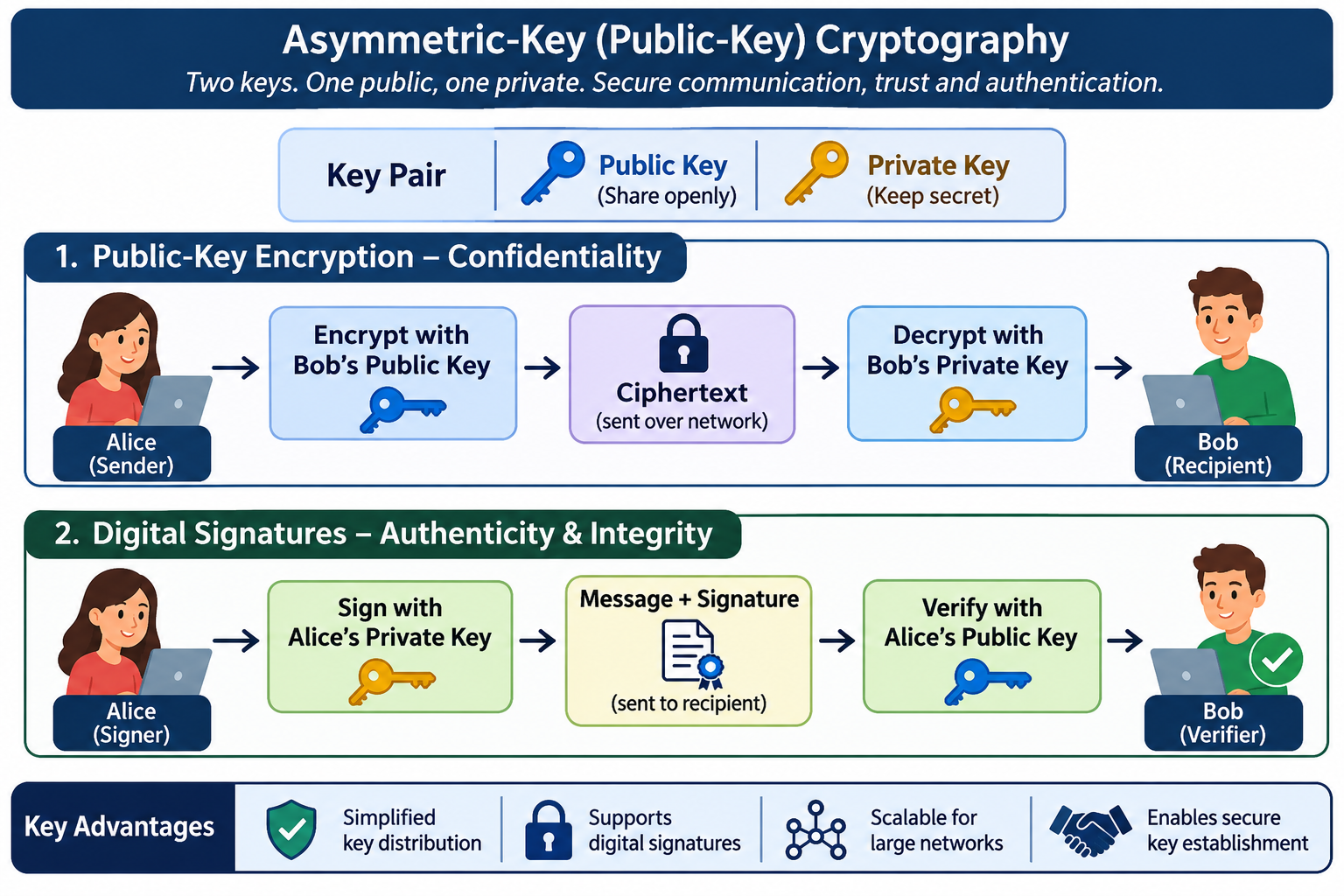
For Example, Suppose Alice Wants To Communicate Securely With Bob. Bob Generates A Public-private Key Pair And Shares His Public Key With Alice. Alice Can Use Bob's Public Key To Encrypt A Message Intended For Him, While Bob Uses His Corresponding Private Key To Decrypt It. Alice Does Not Need To Know Bob's Private Key.
However, Asymmetric Cryptography Supports More Than Encryption. It Also Enables Digital Signatures, Where A Private Key Is Used To Sign Data And The Corresponding Public Key Is Used To Verify The Signature. This Distinction Is Essential Because Encryption Provides Confidentiality, Whereas Digital Signatures Provide Authenticity And Integrity, With Additional Properties Depending On The Protocol And Implementation.
Definition Of Public-Key Cryptography
Public-key Cryptography Is A Cryptographic System Based On A Pair Of Mathematically Related Keys. One Key Is Public And Can Be Distributed To Other Users, While The Other Key Is Private And Must Be Protected By Its Owner.
A Simplified Mathematical Representation Is:
Here:
-
PK represents The Public Key.
-
SK represents The Private Key.
-
KeyGen is The Key-generation Algorithm.
-
λ Represents A Security Parameter That Influences The Strength Of The System.
For Public-key Encryption, A Sender Encrypts A Message M using The Recipient's Public Key:
C = Encrypt(PK, M)
The Recipient Then Uses The Corresponding Private Key To Recover The Message:
M = Decrypt(SK, C)
For A Correctly Functioning Encryption Scheme, Decryption Recovers The Original Message, Subject To The Scheme's Defined Correctness Conditions.
The Security Of The System Does Not Depend On Hiding The Encryption Algorithm Or The Public Key. Instead, It Depends On Protecting The Private Key And On The Computational Difficulty Of Deriving Secret Information From Publicly Available Information.
Historical Development Of Asymmetric Cryptography
Before Public-key Cryptography Was Developed, Most Conventional Cryptographic Systems Relied On Shared Secret Keys. These Systems Could Provide Strong Confidentiality, But Distributing Keys Securely Was A Significant Challenge, Particularly When Communicating Parties Had Never Met.
In 1976, Whitfield Diffie And Martin Hellman Published Their Influential Work On New Directions In Cryptography. They Introduced The Concept Of Public-key Cryptography And Described A Method For Establishing A Shared Secret Over An Insecure Communication Channel. Their Work Became Known As The Diffie–Hellman Key Exchange.
In 1977, Ronald Rivest, Adi Shamir, And Leonard Adleman Developed The RSA Cryptosystem, Which Became One Of The Best-known Public-key Algorithms. RSA Supports Public-key Encryption And Digital Signatures When Used With Appropriate Schemes And Secure Padding.
Other Important Developments Include Elliptic-curve Cryptography (ECC), Which Offers Strong Security With Comparatively Small Keys, And Modern Signature Schemes Such As Ed25519. Post-quantum Cryptography Has Also Become An Important Research And Deployment Area Because Sufficiently Capable Quantum Computers Could Threaten Several Widely Used Public-key Systems.
The Historical Development Of Asymmetric Cryptography Transformed Digital Communication By Making It Possible To Establish Trust, Authenticate Participants, And Negotiate Cryptographic Keys Across Large Networks Without Requiring Every Pair Of Users To Share A Pre-established Secret.
Components Of Asymmetric-Key Cryptography
The Public Key Is Intended To Be Shared With Other Users. Depending On The Algorithm, It May Be Used To Encrypt Data, Verify Digital Signatures, Or Participate In A Key-agreement Protocol. A Public Key Is Not Necessarily Trustworthy Merely Because It Is Publicly Available; Its Association With The Correct Identity Must Be Verified When Authentication Is Required.
The Private Key Is Confidential Information Known Only To Its Authorized Owner Or Cryptographic Device. It Is Used For Decryption In Suitable Encryption Systems, Signing Messages, Or Deriving Shared Secrets In Key-agreement Protocols. If An Attacker Obtains The Private Key, The Security Of The Associated Operations May Be Compromised.
Plaintext Is The Original Readable Information, While Ciphertext Is The Encrypted Representation Produced By An Encryption Algorithm. Properly Designed Encryption Makes Ciphertext Computationally Uninformative About The Plaintext To An Unauthorized Attacker, Under The Scheme's Security Assumptions.
Algorithms Define The Mathematical Procedures Used For Key Generation, Encryption, Decryption, Signing, Verification, And Key Agreement. Examples Include RSA, Elliptic-curve Algorithms, And Diffie–Hellman Key Exchange.
How Asymmetric-Key Cryptography Works
The Operation Of Asymmetric Cryptography Can Be Understood Through A Communication Example Involving Alice And Bob.
Bob Generates A Mathematically Related Public Key And Private Key Using An Appropriate Key-generation Algorithm. The Public Key Can Be Shared With Alice, While The Private Key Remains Under Bob's Control.
Step 2: Public-key DistributionBob Sends Alice His Public Key Or Makes It Available Through A Trusted Directory, Certificate, Or Authenticated Public-key Infrastructure. Alice Must Ensure That The Key Really Belongs To Bob If She Needs Protection Against Impersonation.
Step 3: Message PreparationAlice Prepares A Message That She Wants To Send Securely To Bob. For Example:
"The Confidential Report Is Ready."
The Original Message Is Plaintext.
Step 4: EncryptionAlice Encrypts The Message Using Bob's Public Key And An Appropriate Encryption Scheme. The Encryption Algorithm Produces Ciphertext.
C = Encrypt(PKB, M)
Here, PKB is Bob's Public Key, M is Alice's Message, And C is The Resulting Ciphertext.
Step 5: TransmissionAlice Sends The Ciphertext Over A Communication Channel, Such As The Internet. An Attacker Might Intercept The Ciphertext, But A Secure Encryption Scheme Should Prevent The Attacker From Recovering The Plaintext Without The Necessary Secret Information.
Step 6: DecryptionBob Receives The Ciphertext And Applies His Corresponding Private Key.
M = Decrypt (SKB, C)
Bob Recovers The Original Message If The Ciphertext Is Valid And The Decryption Operation Succeeds.
Step 7: Message AuthenticationIf Bob Also Needs To Verify That The Message Came From Alice And Was Not Altered, Encryption Alone Is Insufficient. Alice Can Digitally Sign The Message Using Her Own Private Signing Key, And Bob Can Verify The Signature Using Alice's Authenticated Public Key.
This Process Demonstrates That Encryption And Digital Signatures Serve Different Security Purposes, Even Though Both May Use Public-key Cryptography.
Public-Key Encryption Versus Digital Signatures
One Of The Most Important Concepts In Asymmetric Cryptography Is The Difference Between Encryption And Digital Signing.
n Encryption, The Recipient's Public Key Is Used To Protect The Message, And The Recipient's Private Key Is Used To Decrypt It. In Digital Signatures, The Sender's Private Signing Key Creates A Signature, And The Corresponding Public Key Verifies It.
A Digital Signature Does Not Automatically Make The Message Confidential. Anyone Who Can Access The Signed Message And Its Public Verification Key May Be Able To Read And Verify It.
Similarly, Encrypting A Message With A Recipient's Public Key Does Not Automatically Prove Who Sent It. Anyone Who Possesses That Public Key Can Generally Encrypt A Message For The Recipient.
It Is Also Important To Correct A Common Misconception: Digital Signatures Are Not Simply The Process Of Encrypting A Message With A Private Key. Modern Signature Algorithms, Including RSA-PSS And EdDSA, Use Dedicated Signing And Verification Procedures.
Major Algorithms Used In Public-Key Cryptography
RSA (Rivest–Shamir–Adleman)
RSA Is One Of The Earliest And Most Widely Recognized Public-key Cryptosystems. Its Security Is Associated With The Computational Difficulty Of Factoring Sufficiently Large Integers Formed As The Product Of Large Primes.
RSA Key Generation Begins By Selecting Large Prime Numbers p And q. Their Product Forms The Modulus:
n = Pq
The System Then Selects Appropriate Public And Private Exponent Values According To The RSA Key-generation Procedure.
The Public Key Contains The Modulus n and Public Exponent e. The Private Key Contains Secret Information, Typically Including The Private Exponent d.
RSA Can Support Encryption And Digital Signatures, But The Correct Scheme Matters. RSA Encryption Should Use A Secure Padding Scheme Such As RSA-OAEP, While Digital Signatures Should Use An Appropriate Signature Scheme Such As RSA-PSS. Raw Textbook RSA Is Not Secure For Practical Use.
RSA Is Commonly Encountered In Certificates, Legacy Systems, Digital Signatures, And Key Establishment. In Modern TLS, RSA Signatures May Still Be Used, But RSA Key Transport Is Not Used In TLS 1.3.
Diffie–Hellman Key Exchange
Diffie–Hellman Is A Key-agreement Method That Allows Two Parties To Establish A Shared Secret Over An Observable Communication Channel. It Is Not, By Itself, An Encryption Algorithm Or A Digital-signature Algorithm.
In A Simplified Version, Alice And Bob Agree On Public Mathematical Parameters. Alice Chooses A Private Value a and Sends A Public Value:
A = Ga Mod P
Bob Chooses A Private Value b and Sends:
B = Gb Mod P
Alice Computes:
K = Ba Mod P
Bob Computes:
K = Ab Mod P
Both Obtain The Same Shared Value Because:
Ba Mod P = Ab Mod P
This Mathematical Equality Illustrates The Core Principle Of Diffie–Hellman Key Agreement. A Practical Implementation Must Derive Cryptographic Keys Using A Suitable Key-derivation Function Rather Than Directly Treating An Arbitrary Shared Value As An Encryption Key.
Basic Diffie–Hellman Does Not Authenticate Participants. Without Authentication, An Attacker Could Conduct A Man-in-the-middle Attack By Establishing Separate Shared Secrets With Alice And Bob. Authenticated Key Exchange Protocols Use Signatures, Certificates, Pre-shared Keys, Or Other Authentication Mechanisms To Prevent This Attack.
Elliptic-Curve Cryptography (ECC)
Elliptic-curve Cryptography Uses Mathematical Operations On Points Of Specially Selected Elliptic Curves Over Finite Fields. Its Security Relies On The Difficulty Of The Elliptic-curve Discrete Logarithm Problem For Suitable Curves And Parameters.
ECC Can Provide Security Comparable To Traditional Public-key Systems Using Much Smaller Keys. This Can Reduce Bandwidth, Storage, And Computational Costs In Many Applications.
Important Elliptic-curve Algorithms Include:
-
ECDH: Elliptic-curve Diffie–Hellman Key Agreement.
-
ECDSA: Elliptic-curve Digital Signatures.
-
EdDSA: A Family Of Digital Signature Schemes, Including Ed25519.
ECC Is Widely Used In Secure Communications, Mobile Devices, Embedded Systems, Digital Certificates, And Modern Cryptographic Protocols.
However, Not Every Elliptic-curve Algorithm Supports Every Public-key Operation. For Example, ECDH Is Used For Key Agreement, While ECDSA And EdDSA Are Used For Digital Signatures.
ElGamal Cryptography
ElGamal Is A Public-key Cryptographic Construction Based On The Discrete Logarithm Problem. It Was Introduced By Taher ElGamal In 1985 And Influenced Several Cryptographic Systems.
ElGamal Encryption Uses A Public Key And Randomized Encryption To Produce Ciphertext. Its Security Depends On The Underlying Mathematical Group And The Scheme's Assumptions.
Traditional ElGamal Encryption Can Produce Ciphertexts Larger Than The Original Message And May Be Less Efficient Than Some Modern Alternatives. Its Underlying Ideas Are Also Related To Public-key Encryption And Signature Constructions In Broader Cryptographic Research.
Implementations Must Use Secure Randomness And Carefully Chosen Parameters. ElGamal Should Not Be Deployed Through An Improvised Implementation For Sensitive Real-world Applications.
Post-Quantum Public-Key Cryptography
Traditional RSA, Diffie–Hellman, And Commonly Used Elliptic-curve Systems Rely On Mathematical Problems That Sufficiently Powerful, Fault-tolerant Quantum Computers Could Solve Efficiently Using Shor's Algorithm.
Post-quantum Cryptography Seeks To Develop Public-key Algorithms That Resist Attacks By Both Classical And Quantum Computers, Under Current Security Assumptions.
A Significant Standardized Example Is ML-KEM, Derived From CRYSTALS-Kyber, Which Is Designed For Key Encapsulation. NIST Standardized ML-KEM In FIPS 203 In 2024. It Allows Communicating Parties To Establish Shared Cryptographic Keys Using A Post-quantum Construction.
For Digital Signatures, NIST Has Standardized ML-DSA, Derived From CRYSTALS-Dilithium, And SLH-DSA, Derived From SPHINCS+. These Algorithms Provide Alternatives To Traditional Signature Systems.
Post-quantum Cryptography Is Increasingly Important For Long-lived Confidential Information, Secure Infrastructure, Government Systems, And Organizations Preparing For Future Cryptographic Migration.
Mathematical Foundations Of Asymmetric Cryptography
Asymmetric Cryptography Relies On Mathematical Structures And Computational Problems That Are Easy To Use In One Direction But Difficult To Reverse Without Secret Information.
Several Important Mathematical Concepts Are Involved.
Prime Numbers: RSA Key Generation Uses Large Prime Numbers. The Product Of Two Appropriately Selected Large Primes Can Be Computed Efficiently, While Recovering The Factors Of A Properly Generated Large Modulus Is Believed To Be Computationally Difficult For Classical Computers At Suitable Key Sizes.
Modular Arithmetic: Modular Arithmetic Deals With Remainders After Division. For Example:
17 Mod 5 = 2
This Operation Appears In RSA, Diffie–Hellman, And Many Other Cryptographic Constructions.
Exponentiation: Efficient Modular Exponentiation Allows Algorithms To Perform Calculations Involving Very Large Exponents Without Calculating Enormous Intermediate Integers.
Discrete Logarithm Problems: Diffie–Hellman And Several Other Public-key Constructions Rely On The Difficulty Of Recovering Secret Exponents From Publicly Visible Mathematical Values.
Elliptic-curve Mathematics: ECC Uses Group Operations On Points Of Elliptic Curves. Appropriate Curve Selection And Secure Implementation Are Essential To Its Security.
These Foundations Support The Construction Of Algorithms That Are Practical To Execute But Difficult For An Attacker To Reverse Without The Relevant Private Information.
Security Services Provided By Asymmetric Cryptography
Asymmetric Cryptography Contributes To Several Important Security Services.
|
Security Service |
Explanation |
|---|---|
|
Confidentiality |
Encryption Can Prevent Unauthorized Parties From Reading Protected Messages. |
|
Authentication |
Digital Signatures And Authenticated Key Exchange Can Help Verify Identities Or Message Origins. |
|
Integrity |
Digital Signatures Can Reveal Unauthorized Modifications To Signed Data. |
|
Non-repudiation Support |
Digital Signatures Can Provide Evidence Supporting Attribution, Subject To Key Control, Identity Verification, And Legal Context. |
|
Secure Key Establishment |
Key-agreement And Key-encapsulation Mechanisms Establish Shared Secrets For Symmetric Encryption. |
These Services Depend On Correct Protocol Design, Secure Key Management, And Trustworthy Public-key Distribution.
For Example, If An Attacker Replaces Bob's Public Key With The Attacker's Own Key, Alice May Unknowingly Encrypt Her Message For The Attacker. This Demonstrates Why Public-key Authentication Is As Important As The Encryption Algorithm Itself.
Digital Certificates And Public-Key Infrastructure
A Digital Certificate Is A Structured Electronic Document That Binds A Public Key To An Identity Or Other Specified Information. Certificates Are Commonly Issued And Digitally Signed By A Certificate Authority (CA).
A Certificate May Contain The Subject's Identity, Public Key, Issuer, Validity Period, Serial Number, And Extensions Describing Permitted Uses. In Common Internet Applications, X.509 Certificates Are Widely Used.
A Public-Key Infrastructure (PKI) Is The Collection Of Policies, Procedures, Cryptographic Mechanisms, And Systems Used To Issue, Validate, Renew, And Revoke Certificates.
For Example, When A Browser Connects To An HTTPS Website, It Validates The Server Certificate And The Associated Trust Chain, Along With Other Required Checks. The Certificate Helps Establish That The Public Key Is Associated With The Intended Domain.
The Certificate Alone Does Not Encrypt All Website Traffic. Instead, TLS Uses Authentication And Key Establishment To Set Up Secure Session Keys, Which Are Then Used By Efficient Symmetric Encryption Algorithms To Protect Application Data.
Hybrid Cryptography: Combining Public-Key And Symmetric Encryption
Asymmetric Cryptography Offers Important Key-management Advantages, But It Is Generally Less Efficient Than Symmetric Cryptography For Encrypting Large Quantities Of Data.
Consequently, Practical Secure Communication Systems Commonly Use Hybrid Cryptography, Which Combines Public-key Techniques With Symmetric Encryption.
-
The Communicating Parties Authenticate One Another When Required.
-
They Use An Appropriate Key-agreement Or Key-encapsulation Mechanism To Establish Shared Secret Material.
-
A Key-derivation Function Converts That Material Into Suitable Cryptographic Session Keys.
-
An Authenticated Symmetric Encryption Algorithm, Such As AES-GCM Or ChaCha20-Poly1305, Encrypts And Authenticates Application Data.
-
The Parties Use The Session Keys According To The Protocol's Rules And Establish New Keys When Required.
The Advantage Of This Architecture Is That Public-key Cryptography Solves Important Key-establishment And Authentication Problems, While Symmetric Cryptography Handles High-volume Data Efficiently.
This Design Is Used In Modern Secure Communication Protocols, Including TLS. The Exact Handshake Mechanisms And Algorithms Depend On The Protocol Version And Configuration.
Advantages Of Asymmetric-Key Cryptography
Simplified Public-key Distribution
Users Can Distribute Public Keys Without Exposing Private Keys. This Reduces The Need To Share A Secret Encryption Key In Advance, Although Authenticating The Public Key Remains Essential.
Support For Digital Signatures
Asymmetric Cryptography Enables Signatures That Can Be Verified Using A Public Key. These Signatures Are Valuable For Software Distribution, Document Signing, Authentication Protocols, And Transaction Approval.
Scalability
In A Network Where Many Users Need Secure Communication, Public-key Systems Can Simplify Key Management. Each User Can Maintain A Key Pair Instead Of Establishing A Unique Long-term Secret With Every Other User.
Authentication
When Public Keys Are Securely Associated With Identities, Cryptographic Signatures And Authenticated Key Exchange Can Help Protect Against Impersonation.
Secure Key Establishment
Key-agreement Mechanisms Can Establish Shared Secrets Over Insecure Networks. This Enables Secure Sessions Without Transmitting The Resulting Secret Directly Across The Network.
Support For Modern Digital Infrastructure
Public-key Cryptography Is Central To HTTPS, Software Signing, Secure Remote Access, Certificate Systems, Encrypted Email, And Many Digital Identity Systems.
Disadvantages And Limitations
Computational Overhead
Many Public-key Operations Require More Computation Than Symmetric Encryption. This Can Increase Processing Time, Energy Consumption, And Communication Overhead.
Larger Keys Or Signatures In Some Systems
Certain Public-key Algorithms Require Relatively Large Keys, Signatures, Or Ciphertexts. Post-quantum Algorithms Can Also Introduce Different Bandwidth And Storage Requirements.
Private-key Compromise
If A Private Key Is Stolen, An Attacker May Impersonate Its Owner, Forge Signatures, Or Decrypt Certain Ciphertexts, Depending On The Algorithm And Protocol.
Public-key Substitution Attacks
If Public Keys Are Not Authenticated, Attackers May Replace Them And Impersonate Legitimate Parties. Certificates, Fingerprints, Trusted Directories, And Authenticated Protocols Help Address This Risk.
Implementation Vulnerabilities
Poor Random-number Generation, Incorrect Padding, Side-channel Leakage, Unsafe Key Storage, Or Programming Mistakes Can Undermine A Theoretically Secure Algorithm.
Quantum-computing Risks
Large, Fault-tolerant Quantum Computers Could Break The Mathematical Assumptions Underlying Many Current Public-key Algorithms. Organizations Therefore Need To Evaluate Post-quantum Migration Plans For Long-lived Systems And Sensitive Information.
No Automatic Protection Against Every Attack
Encryption Does Not Stop Every Form Of Malware, Phishing, Endpoint Compromise, Traffic Analysis, Or Denial-of-service Attack. Public-key Cryptography Must Be Integrated Into A Broader Cybersecurity Architecture.
Applications Of Asymmetric-Key Cryptography
TLS Uses Certificates, Public-key Signatures, And Key-establishment Mechanisms To Authenticate Servers And Establish Secure Session Keys. Symmetric Encryption Then Protects The Web Session's Data.
Electronic Documents, Software Packages, And Firmware Updates Can Be Signed To Support Verification Of Origin And Integrity. Secure Verification Also Depends On Trustworthy Public Keys And Appropriate Validation Procedures.
Systems Such As OpenPGP And S/MIME Use Public-key Techniques For Encryption, Digital Signatures, Or Both. These Mechanisms Can Help Protect Email Confidentiality And Verify Message Integrity.
Public-key Cryptography Helps Authenticate Online Services And Establish Secure Connections For Transactions. Additional Authentication And Fraud-prevention Mechanisms Are Still Needed.
Developers Sign Software Releases With Private Signing Keys. Operating Systems And Other Verification Systems Can Use Corresponding Public Keys To Check Whether A Package Has Been Modified And Whether It Was Signed By A Trusted Publisher.
SSH Supports Public-key Authentication, Allowing A Server To Verify That A Client Possesses The Private Key Corresponding To An Authorized Public Key. Secure Configuration And Private-key Protection Remain Necessary.
Comparison Between Symmetric And Asymmetric Cryptography
|
Feature |
Symmetric Cryptography |
Asymmetric Cryptography |
|---|---|---|
|
Keys |
Shared Secret Key |
Public And Private Key Pair |
|
Key Distribution |
Secret Key Must Be Protected During Distribution |
Public Key May Be Distributed Openly But Should Be Authenticated |
|
Typical Performance |
Very Fast For Bulk Data |
Generally More Computationally Expensive |
|
Encryption |
Same Shared Secret Is Used For Encryption And Decryption |
Public-key Encryption Uses The Recipient's Public Key And Corresponding Private Key |
|
Digital Signatures |
Not Provided By Ordinary Shared-key Encryption Alone |
Supported By Dedicated Signature Algorithms |
|
Key Agreement |
Can Use Pre-shared Secrets Or Other Mechanisms |
Can Establish Shared Secrets Using Key-agreement Or Key-encapsulation Methods |
|
Examples |
AES, ChaCha20 |
RSA, ECDH, ECDSA, Ed25519, ML-KEM |
|
Common Uses |
File Encryption, Database Protection, Session Traffic |
Authentication, Signatures, Key Establishment, And Selected Encryption Tasks |
Both Approaches Are Important. Symmetric Cryptography Is Generally Preferred For Encrypting Large Amounts Of Data, While Asymmetric Cryptography Supports Authentication, Signatures, And Secure Key Establishment.
Practical Example: A Simplified RSA Calculation
The Following Small-number Example Illustrates The Mathematical Idea Behind RSA. It Is For Educational Purposes Only; These Tiny Numbers Are Completely Insecure.
Step 1: Choose Two Prime Numbers.
p = 5, Q = 11
Step 2: Calculate The Modulus.
n = Pq = 5 X 11 = 55
Step 3: Calculate Euler's Totient.
φ(n) = (p-1)(q-1) = 4 X 10 = 40
Step 4: Select A Public Exponent.
Choose:
e = 3
Since 3 And 40 are Coprime, This Is A Suitable Educational Choice.
Step 5: Calculate The Private Exponent.
Find d such That:
ed ≡ 1 (mod 40)
Choosing d = 27 works Because:
3 X 27 = 81 ≡ 1 (mod 40)
The Educational Public Key Is (55,3), And The Private Exponent Is 27.
Step 6: Encrypt A Small Message.
Let The Numerical Plaintext Be M=2. Simplified RSA Encryption Computes:
C = Me Mod N
C = 23 Mod 55 = 8
The Ciphertext Is 8.
Step 7: Decrypt The Ciphertext.
M = Cd Mod N
M = 827 Mod 55 = 2
The Original Message Is Recovered.
This Example Demonstrates The Mathematical Relationship Between The Public And Private Exponents. Real RSA Must Use Large, Securely Generated Keys And Standardized Padding Schemes. Textbook RSA, As Illustrated Here, Must Never Be Used To Protect Real Data.
Key Management And Best Security Practices
The Security Of An Asymmetric Cryptographic System Depends Not Only On Its Mathematical Algorithm But Also On The Lifecycle Management Of Its Keys.
First, Private Keys Should Be Generated Using Trusted Cryptographic Software Or Secure Hardware With An Appropriate Source Of Randomness. Predictable Keys Can Invalidate The Security Of An Otherwise Sound Algorithm.
Second, Private Keys Should Be Protected Through Encrypted Storage, Restricted Permissions, Hardware Security Modules, Trusted Platform Mechanisms, Or Hardware Security Keys Where Appropriate. Access Should Be Limited To Authorized Processes And Users.
Third, Public Keys Must Be Authenticated When Identity Matters. Certificate Validation, Trusted Fingerprints, And Properly Managed Public-key Directories Help Ensure That A Key Belongs To Its Intended Owner.
Fourth, Organizations Should Establish Policies For Key Rotation, Expiration, Revocation, Backup, And Recovery. Compromised Keys Must Be Revoked Or Replaced Promptly, And Affected Certificates Or Credentials Should No Longer Be Trusted.
Fifth, Developers Should Use Established Cryptographic Libraries And Standards Rather Than Implementing RSA, ECC, Padding, Or Key Exchange From Scratch. Correct Library Use Reduces The Risk Of Implementation Mistakes.
Finally, Organizations Should Assess Quantum-related Risks And Plan For Post-quantum Algorithms Where Appropriate. Migration Needs To Account For Protocol Compatibility, Certificates, Hardware Limitations, Long-term Confidentiality, And The Possibility That Encrypted Data Captured Today Could Be Attacked In The Future.
Conclusion
Asymmetric-key Cryptography Is A Foundational Technology For Secure Digital Communication. It Uses A Mathematically Related Public Key And Private Key To Support Operations Such As Encryption, Digital Signatures, And Key Establishment. Unlike Symmetric Cryptography, It Does Not Require Every Communicating Pair To Share A Secret Encryption Key In Advance.
Algorithms Such As RSA, Diffie–Hellman, And Elliptic-curve Cryptography Have Enabled Major Developments In Internet Security, Authentication, And Digital Trust. More Recently, Post-quantum Cryptography Has Introduced New Approaches Intended To Protect Public-key Operations Against Future Quantum-computing Threats.
Nevertheless, Asymmetric Cryptography Is Not A Complete Security Solution By Itself. Its Effectiveness Depends On Correct Algorithm Selection, Public-key Authentication, Private-key Protection, Secure Implementation, And Appropriate Protocol Design. Modern Systems Therefore Combine Asymmetric Techniques With Efficient Symmetric Encryption, Strong Authentication, Certificate Validation, And Sound Key-management Practices.
For Postgraduate Study, The Most Important Distinction To Remember Is That Public-key Encryption Protects Confidentiality, Digital Signatures Support Authenticity And Integrity, And Key-agreement Mechanisms Establish Shared Secrets. Understanding These Separate Functions Provides A Strong Foundation For Advanced Study In Cryptography, Network Security, Secure Protocols, And Cybersecurity Research.
Tags:
Asymmetric-Key, Public-key Encryption, Asymmetric-Key (Public-Key) Cryptography, Public-Key Cryptography