Language Design Issues, Translation, And Compilation Phases: A Complete Guide
Category: COMPUTER SCIENCE | 5th November 2025, Wednesday
Programming Languages Form The Backbone Of Software Development, Providing A Structured Way To Communicate Instructions To Computers. Designing A Programming Language Is Both An Art And A Science — It Involves Careful Consideration Of Syntax, Semantics, Implementation Efficiency, And Usability. To Understand How Code Evolves From Human-readable Instructions Into Executable Machine Code, It Is Essential To Explore Three Key Concepts: language Design Issues, translation, And compilation Phases.
This Blog Provides A Detailed Explanation Of These Topics To Help Students, Developers, And Competitive Exam Aspirants Gain A Clear Understanding Of The Fundamentals.
1. Introduction To Programming Language Design
A programming Language Is A Formal System For Expressing Computations. It Allows Humans To Write Algorithms That Can Be Executed By Computers. The design Of A Programming Language Directly Impacts The Ease Of Programming, Reliability Of Software, And Efficiency Of Execution. A Well-designed Language Strikes A Balance Between expressiveness and performance.
Designing A Language Requires Addressing Several Fundamental Issues Such As Syntax, Semantics, Data Types, Control Structures, Abstraction, And Memory Management.
2. Language Design Issues
Language Design Issues Are Decisions And Trade-offs That Determine How A Language Behaves And How Programmers Interact With It. These Can Be Categorized Into syntactic, semantic, pragmatic, And implementation-related aspects.
a) Syntax Design
Syntax Refers To The form Or Structure of Expressions, Statements, And Program Units. The Syntax Of A Language Defines How Valid Statements Are Written.
Key Syntactic Design Issues Include:
Readability: How Easily Can Programmers Understand The Code?
Example: Python’s Indentation-based Syntax Improves Readability.
Consistency: Does The Language Follow Uniform Rules?
Example: Inconsistent Operator Usage Can Cause Confusion.
Error Handling: How Does The Language Detect And Report Syntax Errors?
Simplicity: The Fewer The Exceptions And Special Rules, The Easier It Is To Learn.
b) Data Types And Structures
Every Programming Language Supports A Variety Of data Types (e.g., Integer, Float, String, Boolean) And data Structures (e.g., Arrays, Lists, Trees). Design Issues Include:
- How Flexible Is The Type System (static Vs. Dynamic Typing)?
- Can New Data Types Be Defined By Users (user-defined Types)?
- How Are Arrays And Pointers Represented And Managed?
c) Control Structures
Control Statements Govern The Flow Of Execution. The Designer Must Decide:
- Which Control Structures (if, While, For, Switch) Are Needed?
- Should The Language Allow goto statements Or Structured Alternatives?
- How Are exceptions And errors handled?
d) Abstraction And Modularity
Modern Languages Support abstraction to Manage Complexity. Important Considerations Include:
- Support For procedures, functions, classes, And modules.
- Scope Rules And visibility of Variables.
- Reusability And Maintainability Through Modular Design.
e) Memory Management
Efficient Memory Management Is Critical. The Language Design Must Decide:
- Whether To Use manual Memory Management (as In C) Or automatic Garbage Collection (as In Java).
- How Memory Allocation And Deallocation Are Handled.
- How To Prevent Memory Leaks And Dangling Pointers.
f) Type Checking And Error Handling
Type Checking Ensures Operations Are Applied To Compatible Data Types.
- Static Type Checking (before Execution) Increases Safety.
- Dynamic Type Checking (during Execution) Increases Flexibility.
Error Handling Strategies—like Exception Handling In Java Or Try-except Blocks In Python—affect Program Reliability.
g) Portability And Efficiency
A Good Language Is machine-independent And Can Run Across Platforms. Designers Must Balance portability (code Reusability) And efficiency (performance On Specific Hardware).
h) Security And Reliability
Languages Should Prevent Unsafe Operations. For Example, Java’s Type System And Runtime Checks Prevent Buffer Overflows That Are Common In C. Reliability Depends On How Predictable And Stable The Language Features Are Under Different Conditions.
3. Program Translation
Once A Programming Language Is Designed, Programs Written In It Must Be translated into Machine Code That The Computer Can Execute. This Process Is Called program Translation.
There Are Three Main Types Of Translators:
a) Compiler
A compiler translates The Entire Source Code Of A Program Into Machine Code Before Execution.
- Output: Executable File (.exe, .out)
- Example Languages: C, C++, Rust
Advantages:
- Faster Execution (since Code Is Pre-translated)
- Better Optimization
- Detects Errors Before Runtime
Disadvantages:
- Longer Initial Compilation Time
- Less Flexibility For Runtime Changes
b) Interpreter
An interpreter translates And Executes The Program Line By Line.
- Example Languages: Python, JavaScript
Advantages:
- Easier Debugging
- Immediate Feedback During Development
Disadvantages:
- Slower Execution
- Requires Interpreter Presence At Runtime
c) Assembler
An assembler Converts assembly Language (a Low-level, Symbolic Representation Of Machine Code) Into Executable Machine Code.
Example:
is Translated To Binary Machine Instruction By The Assembler.
4. The Compilation Process: Phases Of A Compiler
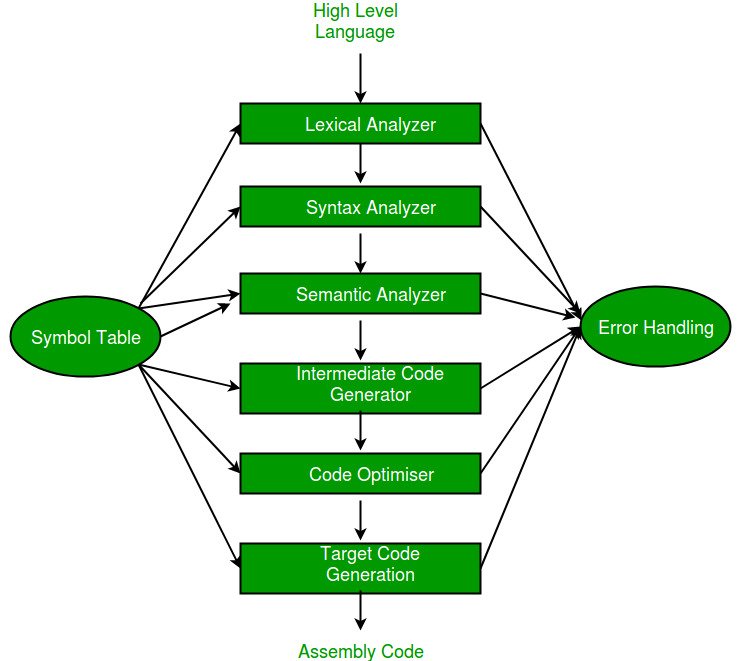
The compiler Is A Complex Software System That Performs Translation Through Several Well-defined phases. Each Phase Takes Input From The Previous Phase And Passes Processed Output To The Next.
The phases Of Compilation Can Be Broadly Divided Into front-end, middle-end, And back-end stages.
4.1 Front-End Phases
These Deal With The analysis of Source Code.
a) Lexical Analysis (Scanning)
- Breaks Source Code Into tokens (identifiers, Keywords, Literals, Operators).
- Removes Whitespace And Comments.
- Example:
For int A = 5;
Tokens Are [int] [a] [=] [5] [;]
- Tool Used: Lexical Analyzer Or Lexer.
b) Syntax Analysis (Parsing)
- Checks If The Sequence Of Tokens Follows The grammar Rules of The Language.
- Builds A Parse Tree or Syntax Tree.
- Detects Syntax Errors Like Missing Semicolons Or Mismatched Parentheses.
c) Semantic Analysis
- Ensures The Code Is meaningfully Correct.
- Checks Data Type Compatibility, Variable Declarations, And Scope Rules.
- Example:
int X = "hello"; → Semantic Error (type Mismatch).
d) Intermediate Code Generation
Converts Syntax Tree Into An intermediate Representation (IR), Which Is Closer To Machine Code But Still Platform-independent.
Example IR: Three-address Code (TAC)
T1 = A + B
T2 = T1 * C
4.2 Middle-End Phase
e) Code Optimization
Improves Performance And Reduces Resource Usage.
Examples Of Optimizations:
- Constant Folding: Replace `5 + 3` With `8`.
- Dead Code Elimination: Remove Unreachable Code.
- Loop Optimization: Minimize Repeated Calculations Inside Loops.
4.3 Back-End Phases
These Deal With The generation Of Target Code.
f) Code Generation
- Converts Optimized Intermediate Code Into Target Machine Code.
- Handles Register Allocation And Instruction Selection.
Example:
MOV R1, A
ADD R1, B
MUL R1, C
g) Code Linking And Loading
- Linking: Combines Multiple Object Files And Libraries Into A Single Executable.
- Loading: Places The Executable Into Memory For Execution.
- Loader assigns Memory Addresses And Initiates Execution.
5. Example: Compilation Process Overview
Here’s A Simplified View Of How A C Program hello.c Is Compiled:
1. Preprocessing: Handles Directives Like #include And #define.
2. Compilation: Converts Preprocessed Code Into Assembly.
3. Assembly: Translates Assembly Code Into Object Code (`.obj` Or `.o`).
4. Linking: Combines Object Files And Libraries Into An Executable.
5. Loading: The OS Loads The Program Into Memory For Execution.
6. Compiler Vs Interpreter Vs Assembler (Comparison Table)
| Feature | Compiler | Interpreter | Assembler |
| Input | High-level Code | High-level Code | Assembly Code |
| Output | Machine Code | Executes Directly | Machine Code |
| Execution Speed | Fast (after Compilation) | Slow | Fast |
| Error Detection | At Compile Time | Line-by-line During Execution | During Assembly |
| Examples | C, C++ | Python, JavaScript | MASM, NASM |
7. Importance Of Studying Compilation Phases
Understanding Compilation Phases Is Essential For:
- Debugging: Knowing Where Errors Occur (syntax, Semantic, Or Runtime).
- Optimization: Writing Efficient Code.
- Designing Languages: Helps In Creating Interpreters Or Compilers.
- Competitive Exams: Topics Like Lexical Analysis, Parsing, And Code Optimization Are Frequent In GATE and UGC NET Computer Science Papers.
8. Real-World Relevance
Modern Compilers Like GCC, LLVM, And Clang Implement Advanced Optimization Techniques For High Performance. In Web Development, JIT (Just-In-Time) Compilers in JavaScript Engines (like V8 In Chrome) Combine Interpretation And Compilation For Better Speed And Flexibility.
Language Design Choices—like Python’s Readability Or Rust’s Safety—are Directly Influenced By How Compilers Manage Memory, Enforce Type Rules, And Optimize Execution.
9. Conclusion
The Journey From High-level Programming To Executable Machine Code Involves Multiple Intricate Steps, From Language Design To Translation And Compilation. Each Stage — From Lexical Analysis To Code Generation — Ensures That Human-readable Instructions Are Transformed Into Efficient, Reliable, And Portable Machine Code.
By Mastering These Concepts, Students And Developers Not Only Understand how Compilers Work But Also Gain Insights Into how Programming Languages Are Built, why They Differ, And how Performance Can Be Improved through Thoughtful Language Design And Optimization.
Tags:
Language Design Issues, Translation In Compiler Design, Compilation Phases, Compiler Vs Interpreter, Phases Of Compilation, Syntax And Semantics, Compiler Design GATE Notes, Code Optimization, Program