Dijkstra Algorithm And OSPF
Category: ALGORITHM | 31st August 2026, Monday
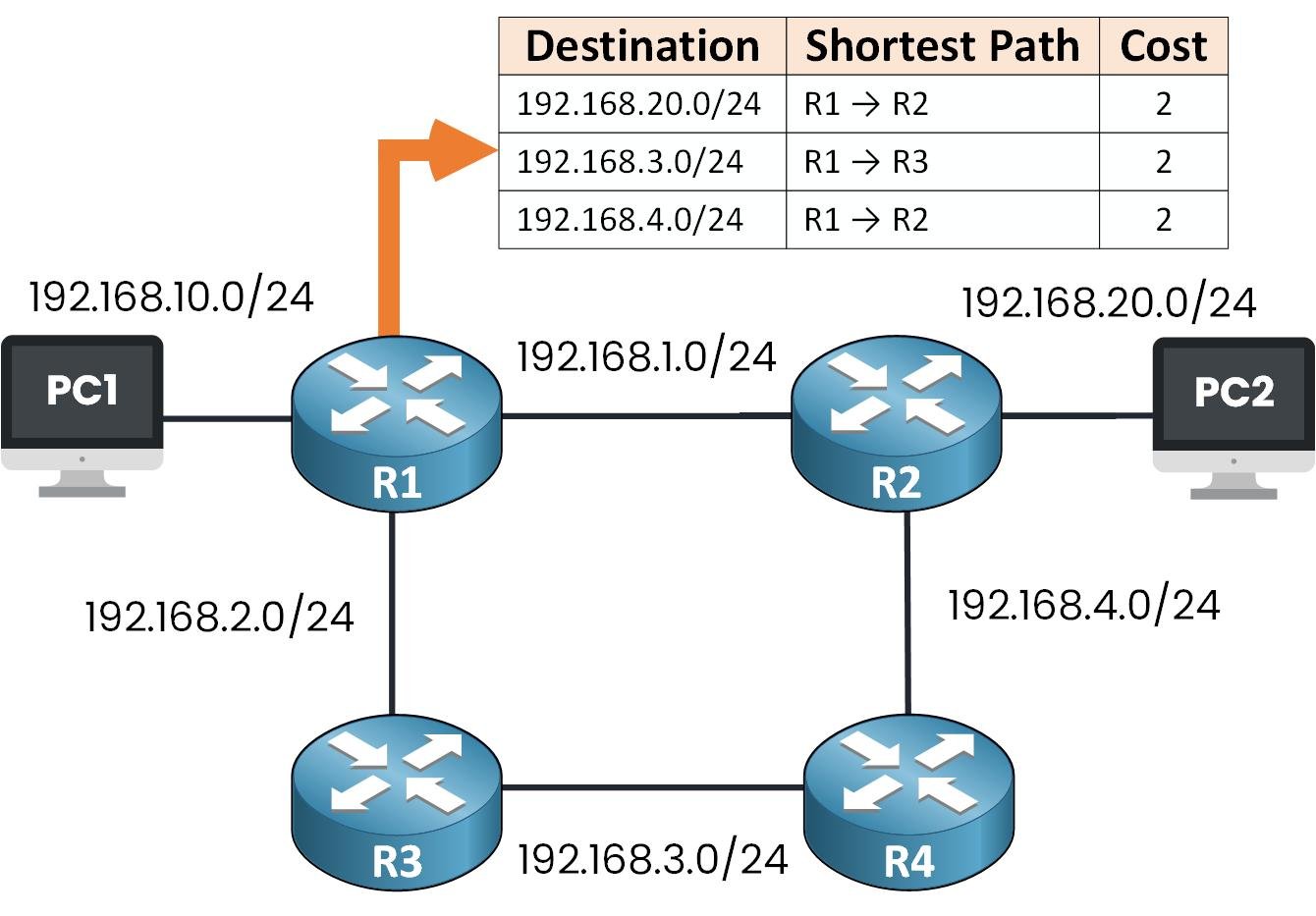
Introduction
Dijkstra's Algorithm And OSPF (Open Shortest Path First) Are Closely Related Concepts In Computer Networking. OSPF Is A Layer 3 (Network Layer) Link-state Routing Protocol, And It Uses The Shortest Path First (SPF) Algorithm Based On Dijkstra's Algorithm To Calculate The Best Routes Through A Network.


What Is Dijkstra's Algorithm?
Dijkstra's Algorithm Is A shortest-path Algorithm Used To Find The Minimum-cost Path Between Nodes In A Weighted Graph. In Networking, Routers Can Be Represented As Nodes, While Network Links Can Be Represented As Edges. Each Link Has A Numerical cost, And Dijkstra's Algorithm Determines The Path With The Lowest Total Cost.
For Example, Consider:
        10
   R1 -------- R2
    |           |
   5|           |10
    |           |
   R3 -------- R4
        5
If A Router Needs To Reach R4 From R1, Possible Paths Include:
-
R1 → R2 → R4 = 10 + 10 = 20
-
R1 → R3 → R4 = 5 + 5 = 10
Therefore, The Shortest Path Is:
R1 → R3 → R4
Total Cost = 10
How OSPF Uses Dijkstra's Algorithm?
OSPF Uses Dijkstra's Algorithm To Perform Its Shortest Path First (SPF) Calculation. An OSPF Router First Learns The Topology Of Its OSPF Area Through Link-State Advertisements (LSAs). These LSAs Are Stored In The Router's Link-State Database (LSDB).
The Router Then Treats The LSDB As A Graph:
LSDB
 ?
 ?
Network Topology
 ?
 ?
Routers + Links + Costs
 ?
 ?
Dijkstra SPF Algorithm
 ?
 ?
Shortest Path Tree
 ?
 ?
Routing Table
Thus, Dijkstra's Algorithm Is Not Itself A Routing Protocol. OSPF Is The Routing Protocol, While Dijkstra's Algorithm Is One Of The Fundamental Algorithms OSPF Uses For Route Calculation.
OSPF Link-State Database
Before Running SPF, An OSPF Router Needs Information About The Network Topology. OSPF Routers Exchange LSAs With Their Neighbors. These LSAs Describe Links, Networks, And Other Routing Information.
The Information Is Organized Into The Link-State Database (LSDB).
For Example:
             R2
           /    \
        10        20
        /          \
       R1 --- 5 --- R3
The Router Can Use The LSDB To Understand:
-
Which Routers Exist
-
Which Routers Are Connected
-
Which Networks Are Reachable
-
What The Link Costs Are
-
Which Interfaces Connect To Particular Destinations
The SPF Algorithm Uses This Information To Calculate The Best Routes.
Dijkstra's Algorithm Step-by-Step In OSPF
Suppose The Topology Is:
             10
        R1 -------- R2
        |            |
       5|            |10
        |            |
        R3 -------- R4
             5
Assume R1 Wants To Calculate Routes To All Other Routers.
Step 1: Start At R1
The Algorithm Begins With R1 As The Source.
R1 = 0
R2 = 10
R3 = 5
R4 = ∞
Here, ∞ Means That R4 Has Not Yet Been Reached.
Step 2: Select The Lowest-cost Unvisited Router
R3 Has Cost 5, Which Is Lower Than R2's Cost Of 10.
Therefore:
Select R3From R3, The Router Can Reach R4 With A Cost Of 5.
Therefore:
R1 → R3 → R4

Cost = 5 + 5
     = 10
The Cost To R4 Becomes 10.
Step 3: Continue The Calculation
The Router Now Compares The Remaining Possibilities. It Can Reach R2 With Cost 10 And R4 With Cost 10.
The Resulting Shortest Paths Can Be Represented As:
R1
|--- R3 = 5
     ---R4 = 10
|
|-- R2 = 10
OSPF Uses This SPF Tree To Determine The Next Hop For Destinations.
What Is OSPF Cost?
Dijkstra's Algorithm Requires A Value Representing The Weight Of Each Link. In OSPF, This Value Is Called cost.
Conceptually:
OSPF Cost
    ↓
Weight Of A Network Link
    ↓
Used By SPF Calculation
    ↓
Lower Total Cost = Preferred Path
OSPF Commonly Derives Interface Cost From Bandwidth, Depending On The Implementation And Configuration. Administrators Can Also Explicitly Configure Interface Costs.
For Example:
Path A:
R1 → R2 → R4
10 + 20 = 30

Path B:
R1 → R3 → R4
10 + 10 = 20
OSPF Selects Path B Because:
20 < 30Dijkstra Produces An SPF Tree
One Important Concept Is That Dijkstra's Algorithm Doesn't Simply Produce A List Of Routes. It Constructs A Shortest Path Tree (SPT) Rooted At The Calculating Router.
For Example:
             R1
            /  \
           /    \
          R2     R3
                  \
                   R4
If R1 Is The Root, The Tree Represents The Lowest-cost Paths From R1 To Other Destinations.
OSPF Then Uses This Information To Determine Routing-table Entries.
Relationship Between OSPF And Dijkstra
The Relationship Can Be Summarized As:
| Component | Function |
|---|---|
| OSPF | Routing Protocol |
| LSA | Carries Link-state Information |
| LSDB | Stores Topology Information |
| SPF | Calculates Shortest Paths |
| Dijkstra | Algorithm Used For SPF Calculation |
| Routing Table | Contains Selected Routes |
| IP Forwarding | Sends Packets Toward Destinations |
The Complete Process Is:
OSPF Neighbors
      ↓
Exchange LSAs
      ↓
Build LSDB
      ↓
Run Dijkstra/SPF
      ↓
Build Shortest Path Tree
      ↓
Select Best Routes
      ↓
Install Routes
      ↓
Forward IP Packets
Why Dijkstra Is Important To OSPF
Without An SPF Calculation, An OSPF Router Would Have Difficulty Determining The Optimal Path Through A Complex Topology. Dijkstra Provides A Systematic Mathematical Method For Finding Minimum-cost Paths.
This Is Particularly Important When A Network Contains:
-
Multiple Routers
-
Multiple Paths
-
Different Link Speeds
-
Redundant Connections
-
Link Failures
-
Large Numbers Of Destinations
When The Topology Changes, OSPF Can Update Its Topology Information And Perform Another SPF Calculation To Determine New Paths.
OSPF Is Not A Data Link Layer Protocol
It Is Also Important To Connect This Topic With Your Previous Question About OSPF And The Data Link Layer.
OSPF Operates At The Network Layer (Layer 3), Not The Data Link Layer (Layer 2).
For Example:
Application Layer
       ↓
Transport Layer
       ↓
Network Layer
   ?????????????
   ?   OSPF    ?
   ? Dijkstra  ?
   ?????????????
       ↓
Data Link Layer
   Ethernet/Wi-Fi
       ↓
Physical Layer
Ethernet Or Wi-Fi Provides Local Frame Transmission, While OSPF Determines How IP Networks Should Be Interconnected Through Routers.
Final Summary
Dijkstra's Algorithm Is The Mathematical Foundation Behind OSPF's Shortest Path First Calculation. OSPF Collects Topology Information Through LSAs, Stores That Information In The LSDB, And Then Uses An SPF Calculation Based On Dijkstra's Algorithm To Determine The Lowest-cost Paths. The Resulting Shortest-path Information Is Used To Populate The Routing Table And Forward IP Packets Efficiently.
In Simple Terms:
OSPF Learns The Network Topology; Dijkstra Calculates The Shortest Paths; The Routing Table Uses Those Paths For Packet Forwarding.
So, The Easiest Way To Remember The Relationship Is:
OSPF = Routing Protocol
LSA = Topology Information
LSDB = Topology Database
Dijkstra/SPF = Path Calculation
Routing Table = Selected Routes
Tags:
OSPF, Routing Protocol, LSA, Topology Information, Dijkstra, SPF, Routing Table, Selected Routes, Path Calculation